Which Vegetables Are Highest in Polyphenols?
Sep 10, 2026
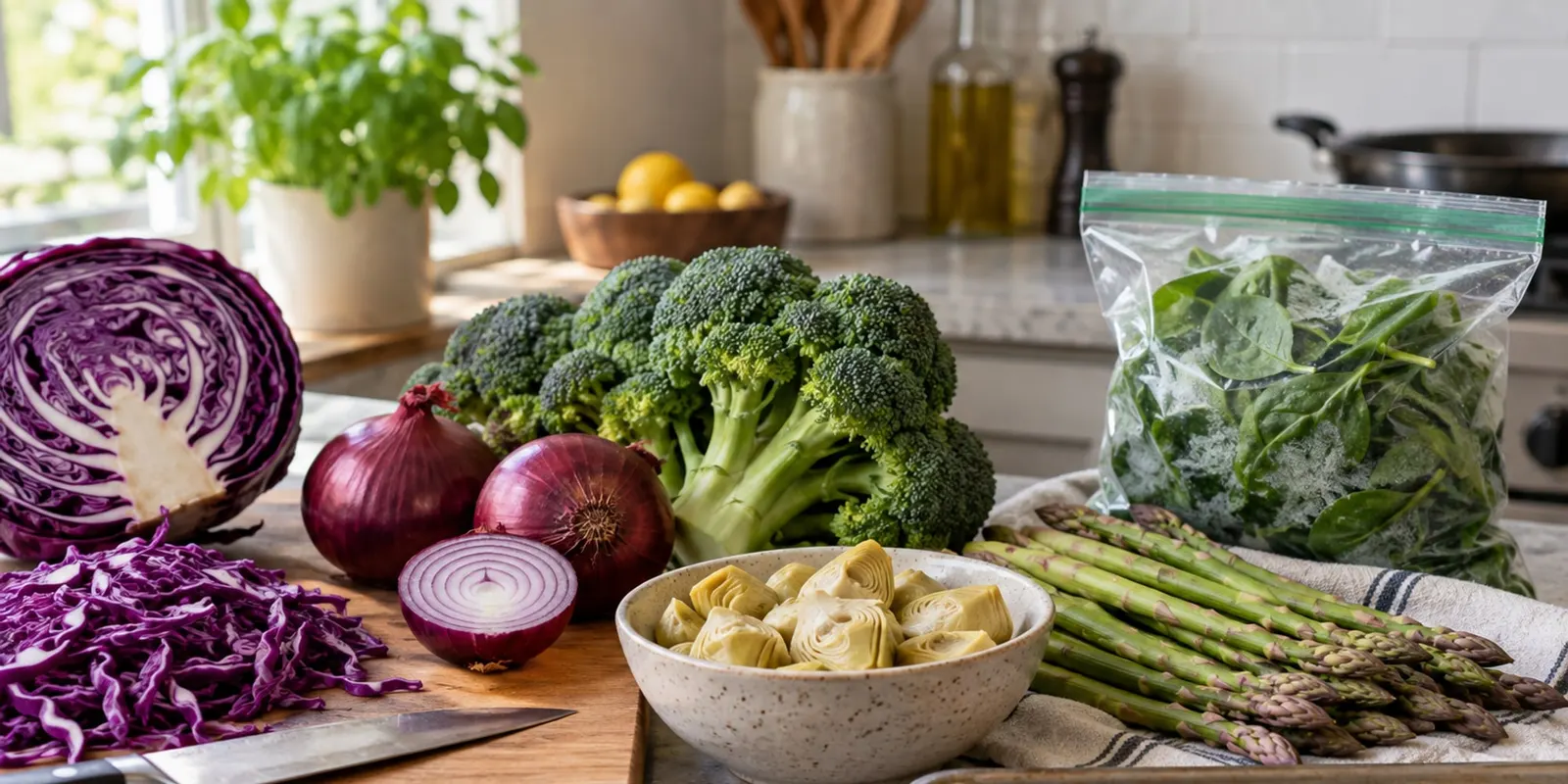
If you're standing in produce with a shopping list, globe artichokes, red onions, spinach, red cabbage, broccoli, and asparagus are the vegetables to put near the top. That's the direct answer to which vegetables are highest in polyphenols. It also needs one warning: rankings usually compare 3.5 ounces of raw food, even when nobody eats that amount of the item in question. Buy a mix you'll cook in real portions. Red cabbage that lasts two weeks may contribute more to your diet than a theoretically higher vegetable that wilts untouched.
The short list
Globe artichoke usually leads the common-vegetable lists. Red onion, spinach, red cabbage, broccoli, and asparagus make up the useful next tier. You don't need all six every week. Pick two sturdy choices and one or two vegetables you'll use early.
| Vegetable | Why it ranks | How it is usually eaten |
|---|---|---|
| Globe artichoke | Consistently at or near the top in composition databases | Whole, or hearts |
| Red onion | Concentrated in the outer layers | Raw or cooked, in small amounts across many meals |
| Spinach | High per 100 grams, easy to eat a lot of | Raw or lightly wilted spinach |
| Red cabbage | Anthocyanins give it the color and the content | Raw, shredded, or lightly cooked |
| Broccoli | Solid content and eaten in real portions | Steamed rather than boiled |
| Asparagus | High among common vegetables | Roasted or steamed |
Artichoke hearts are easier on a Tuesday night than whole artichokes. Frozen spinach is easier still. A head of red cabbage can become slaw, tacos, soup, or a quick skillet side without racing the clock. Red onion works in small amounts across several meals. Broccoli and asparagus come in portions people recognize and cook.
I wouldn't treat the order as a medal table. Polyphenol content shifts with the variety, ripeness, growing conditions, storage, and preparation. The point of the ranking is to make your cart easier to fill. For most kitchens, red cabbage, frozen spinach, and red onion are the safest starting trio because they're flexible and less likely to be wasted.
How these rankings are built
Food-composition researchers analyze a sample, identify polyphenol compounds, and report a total or a set of values. Lists often standardize those results to 3.5 ounces of raw food so unlike vegetables can be compared on the same weight. That makes a tidy table. Your dinner is messier.
The sample may be one cultivar harvested at one stage of ripeness. Another farm, season, or storage period can produce a different result. Researchers also use different extraction and measurement methods. A total from one database won't always line up cleanly with a total from another. The number is an average for a measured sample. Nobody ran a laboratory test on the bunch in your hand.
Raw values also freeze the food before the kitchen has a chance to change it. You might boil artichokes, wilt spinach, roast asparagus, shred cabbage, and sauté onions. Heat, water, and cutting can change what remains. Then digestion, absorption, and gut bacteria transform the compounds again. What reaches the bloodstream doesn't match what a lab extracted from raw food.
Use rankings to identify a promising group. Don't use them to pretend you know an exact daily dose. The useful question is whether a vegetable ranks reasonably well, fits a normal portion, and will get cooked before it spoils. That's enough precision for a shopping list.
Why per 100 grams misleads
A standard 3.5-ounce comparison treats every food as if people eat the same weight. They don't. Three and a half ounces of spinach is a substantial pile before cooking. The same weight of dried oregano would be an absurd meal. A whole globe artichoke also includes parts you won't eat, while a bowl of cooked artichoke hearts is all edible.
Portion size can change the practical ranking. Broccoli may sit below another vegetable per 3.5 ounces, but a full cup of broccoli is ordinary at dinner. Red onion can rank well while appearing in a sandwich as a few rings. Spinach shrinks dramatically in the pan, so a large raw volume becomes a manageable cooked portion. That's why the table includes how each vegetable is usually eaten.
A serving number still won't tell you what your body uses. Digestion and gut microbes alter polyphenols before circulation. The fiber and other nutrients in whole vegetables come along for the ride, which is one reason the entire food matters more than the isolated total.
When someone offers a "Foods high in polyphenols PDF," check whether it shows serving sizes or only standardized weights. A "Foods high in polyphenols PDF" can be a handy shopping prompt, though its decimal points shouldn't be mistaken for precision at the plate. Your usual portion completes the comparison.
Color as a rough guide
Color gives you a rule you can use without opening a database in the aisle. Many of the pigments that make vegetables red, purple, or deep green are polyphenols. Red cabbage gets its purple-red color from anthocyanins. Red onion concentrates colored compounds in its outer layers. Spinach's green comes from chlorophyll, though the leaves also contain polyphenols.
The rule is rough. Pale artichoke ranks very well, and dark color doesn't reveal portion size, freshness, or how the vegetable was stored. Still, filling the cart with several colors usually pushes you toward more plant variety. A red cabbage, green broccoli, purple onion, and pale artichoke hearts cover more ground than five packages of the same vegetable.
Color also makes substitutions easier. If the asparagus looks tired, buy broccoli. If fresh spinach will wilt before you cook it, take frozen. If artichokes are expensive, canned or jarred hearts can make the meal realistic. The exact hierarchy matters less once you're choosing among several solid options.
Polyphenol-rich fruits and vegetables follow the same broad color cue. Keep the whole produce section in play. Fruit and vegetables contribute different compounds, so it makes sense to eat both across the week.
Are beets high in polyphenols? They're deeply colored and can fit the same variety rule, though this brief doesn't rank them above artichoke or the short list. Foods high in polyphenols and flavonoids often overlap because flavonoids are one large polyphenol family. The color cue is useful for both.
Herbs and spices, and why they sit apart
Herbs and spices can outrank every vegetable per gram. They've lost water, or they're naturally concentrated, so the standardized comparison rewards them. The portion fixes the illusion. You might use a teaspoon of dried oregano or a pinch of cloves. You could eat several ounces of broccoli without trying.
That doesn't make seasonings irrelevant. Oregano, rosemary, thyme, cinnamon, and cloves can add polyphenols while making vegetables easier to repeat. The contribution is small each time, but it can recur through the week. A jar you actually open is more useful than a higher-ranked one bought for a list and forgotten.
Fresh herbs sit somewhere between leafy vegetables and dry seasoning in practical use. A handful of parsley can disappear into a salad or bean dish. Basil can become part of a sauce. Still, it would be odd to tell someone that herbs answer which vegetables are highest in polyphenols when the person wants dinner.
Keep them as an add-on. Buy vegetables in real portions, then use herbs and spices to vary the flavor. Check your cabinet before shopping, since ground seasonings lose aroma during long storage. The best candidate is one that works with food you already cook. A small jar used regularly makes more sense than five dusty jars bought for their rankings. Portion and frequency settle the issue.
What cooking does to the ranking
Cooking changes the raw ranking, and the method matters. Water-soluble compounds can move from a vegetable into the cooking water. If that water goes down the drain, those compounds go with it. Steaming uses less direct contact with water, while roasting and sautéing create a different mix of heat and moisture.
A 2010 study of brassica vegetables compared boiling, microwaving, and steaming and measured changes in phytochemical content. A 2014 leek study found that boiling lowered total phenolic content in both the white shaft and green leaves. Those results don't produce one rule for every compound in every vegetable. They do make raw rankings a starting point.
You can keep the kitchen advice simple. Steam or lightly sauté vegetables when you like them that way. If you boil, use the liquid in soup or sauce. Avoid cooking something into submission solely because a recipe gives a long time. Raw red cabbage and onion work well when your stomach tolerates them, and lightly wilted spinach takes only a few minutes.
Our full guide to what cooking costs goes further. For tonight, use the method that helps you eat the vegetable. A theoretically perfect raw serving doesn't help if you dislike it. Cooking can make a large portion of spinach or broccoli much easier to finish. Keep the liquid when it belongs in the dish.
Fresh, frozen and stored
Frozen vegetables aren't automatically worse than fresh. They're often picked and processed quickly. Fresh vegetables may spend days in transport, under retail lights, and in your refrigerator. Storage time and light can lower polyphenol content before the pan ever heats.
The best format depends on timing. Fresh asparagus has a texture the freezer doesn't reproduce well, so buy it when you'll cook it soon. Frozen spinach and broccoli are dependable backups. Red cabbage and red onions keep well in the refrigerator, which makes them useful for the end of the week. Canned artichoke hearts trade some texture for convenience.
Look at how the vegetable will enter your meals. A freezer bag lets you pour out one portion and save the rest. Fresh produce invites you to build dinner around it, which can be helpful when it's good. Neither label tells you the exact polyphenol content. Cultivar, processing, and time all get a vote.
If you've thrown away one too many slimy spinach bags, buy frozen without guilt. The vegetable you eat has an advantage no composition database can capture. Keep delicate fresh purchases visible, and move hardy cabbage and onions to the back of the week's plan. A mixed fresh-and-frozen cart gives you produce for tonight and insurance for Friday. It also reduces the pressure to use every vegetable at once.
How to actually shop from this
Build the list around four roles. Choose one vegetable for raw use, one for quick cooking, one that keeps, and one frozen backup. That could mean red cabbage for slaw, asparagus for Tuesday dinner, red onion for the week, and frozen spinach for whatever night goes sideways.
Then rotate. Next week, swap broccoli for asparagus and artichoke hearts for spinach. Eating a range covers more polyphenol classes than eating a large amount of one top-ranked vegetable. Browse more polyphenol-rich foods when you want a different set of choices.
These vegetables bring fiber and can make meals more filling, but their polyphenols don't turn them into fat-burning tools. Buy vegetables because they work in meals, not because a list promises a shortcut.
MCT oil is a separate fat choice and isn't a meaningful vegetable polyphenol source. Keep it separate from the artichokes, onions, spinach, cabbage, broccoli and asparagus on this list.
How much polyphenols per day is a reasonable goal? No universal daily target has been established. Polyphenols benefits also can't be reduced to the position of one vegetable on a chart. A varied food pattern has broader evidence behind it than a supplement-style dose chase.
Common questions
What are the top 5 foods rich in polyphenols?
Among vegetables, globe artichoke, red onion, spinach, red cabbage, and broccoli make a practical top five. Asparagus also ranks well. The order changes with the database, cultivar, portion, storage, and cooking method. Buy several rather than treating the highest entry as the only one that counts.
Can you give me a list of 100 foods high in polyphenols?
A 100-food list would include fruit, vegetables, herbs, spices, nuts, legumes, grains, coffee, and tea. For vegetables, start with artichoke, red onion, spinach, red cabbage, broccoli, and asparagus. Eating a range of vegetables covers more classes of polyphenols than loading every meal with the single top-ranked choice.
What fruit has the highest polyphenols?
Berries lead many fruit rankings, especially blackberries, blueberries, blackcurrants, and elderberries. That answer doesn't change the vegetable list: globe artichoke, red onion, spinach, red cabbage, broccoli, and asparagus still rank well. Eat fruit and vegetables across the week rather than asking one side of produce to do all the work.
What drink is highest in polyphenols?
Coffee and tea are major everyday sources because people drink them often. A drink ranking doesn't replace vegetables. Deeply colored vegetables tend to carry more polyphenols, and herbs and spices can outrank them per gram while being eaten in far smaller amounts. Portion and frequency make the useful comparison.
What vegetable has the most polyphenols?
Globe artichoke is consistently among the highest common vegetables in composition databases. Red onion, spinach, red cabbage, broccoli, and asparagus also rank well. Since published values are usually based on a standardized raw weight, the vegetable you'll eat in a normal portion may matter more than the nominal winner.
Are frozen vegetables as good as fresh?
Frozen vegetables can be just as useful for this shopping goal. They're often processed quickly after picking, while fresh vegetables may spend days in storage and light. The exact polyphenol level varies in both. Choose fresh when you'll eat it soon and frozen when it keeps good food from becoming waste.
The list to shop from
Photograph this: globe artichoke or artichoke hearts, red onions, spinach, red cabbage, broccoli, and asparagus. Choose three or four, including one frozen option. Add herbs or spices you'll actually use. Polyphenol-rich fruits and vegetables work best as a varied group. If you remember one instruction, make it this: rotate colors and buy realistic portions. That's more useful than memorizing which vegetables are highest in polyphenols.
Food is the foundation, and vegetables make that foundation easy to see on the plate. A standardized supplement can be useful for a specific goal when human evidence supports the ingredient and dose, though it won't replace the fiber, volume and variety in the cart.