Quercetin vs Curcumin: Compare Claims, Not Hype
Oct 20, 2026
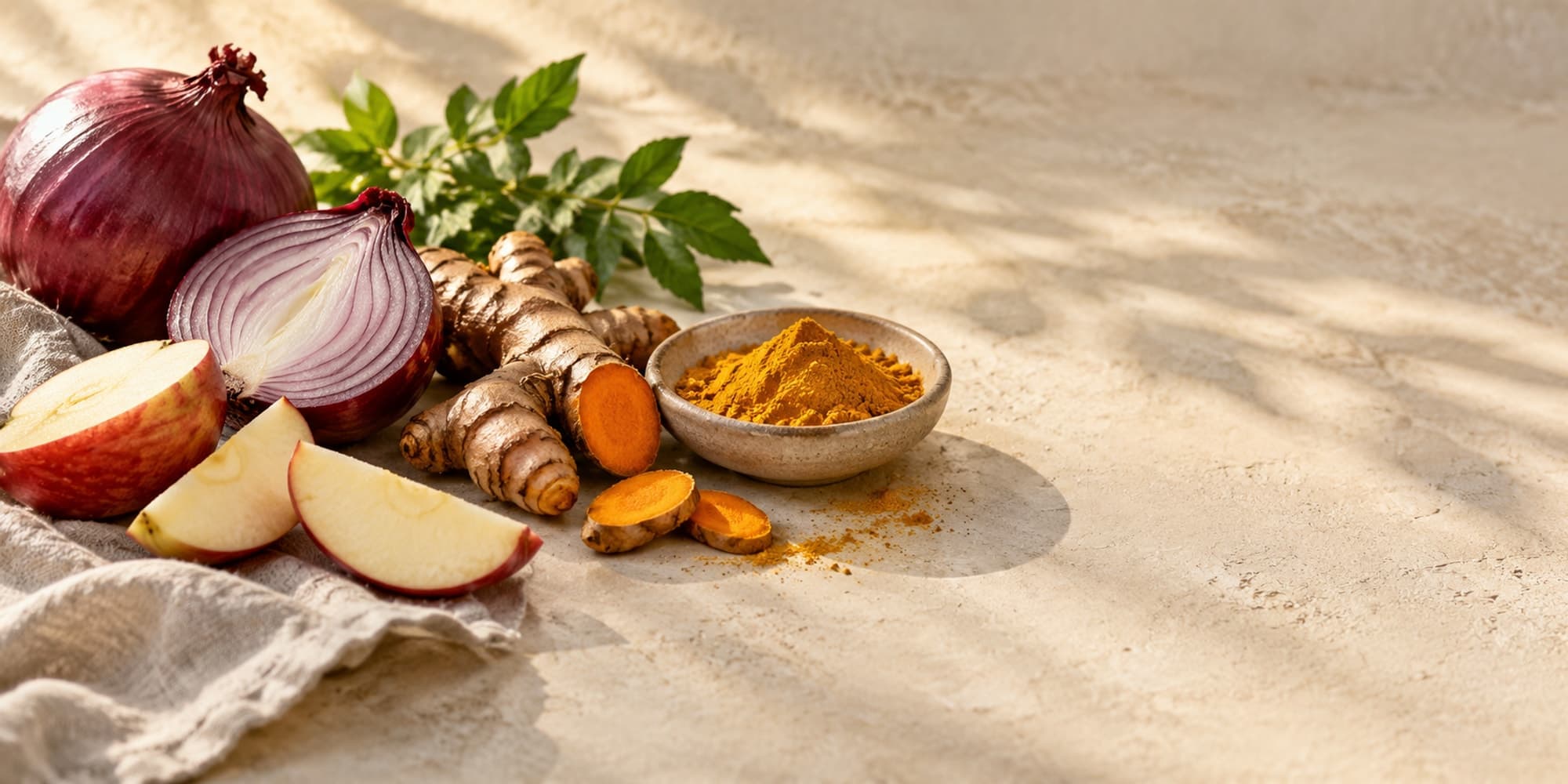
Quercetin and curcumin often land on the same supplement shelf, surrounded by the same vague words about antioxidants and inflammation. Chemically, they aren't close substitutes. Quercetin is a flavonoid found in onions, apples, capers, kale, and tea. Curcumin is one of the yellow curcuminoids concentrated from turmeric.
If you're choosing ingredients for dinner, use both when they taste good. If you're comparing capsules, forget the shared marketing language and read the forms, doses, and human trials separately.
Two different compounds
Quercetin belongs to the flavonol branch of the flavonoid family. Curcumin belongs to a smaller group called curcuminoids. In ordinary language, one is associated with foods such as red onions and capers; the other is part of the spice that turns a curry or pot of rice yellow.
That kitchen picture matters because food and concentrated extracts create different exposures. An onion contains quercetin alongside fiber, water, sugars, and other plant compounds. Turmeric powder contains a modest mixture of curcuminoids. A capsule can isolate or concentrate either ingredient far beyond what you would normally eat.
Same shelf, different ingredients
A flavonol found across many everyday foods.
A curcuminoid concentrated from turmeric.
Match one defined product to one defined goal.
Foods versus concentrated products
A quercetin label may list quercetin aglycone, a form different from the sugar-bound quercetin commonly found in foods. A curcumin label might mean turmeric powder, a standardized curcuminoid extract, or a branded delivery system. Those descriptions change the comparison.
Black pepper adds another wrinkle. Piperine from black pepper can increase exposure to curcumin, which is why it appears in some formulas. That doesn't mean sprinkling pepper over turmeric recreates a clinical trial, and it doesn't mean every piperine formula has proved a useful outcome.
In the kitchen, precision is unnecessary. Sauté the onions. Add turmeric because it works in the dish. Treating dinner as a disappointing supplement dose gets the comparison backward. The meal still counts when you haven't measured either compound.
| Question | What the evidence says | Practical meaning |
|---|---|---|
| Quercetin | A flavonol usually bound to sugars in food | Supplement aglycone differs from food forms |
| Curcumin | A curcuminoid concentrated from turmeric | Turmeric powder isn't a standardized curcumin extract |
| Supplement label | Both supplement categories vary in form and amount | Compare the exact ingredient, dose, carrier, and testing |
Why absorption claims dominate
Both compounds are often described as poorly absorbed. Formulators respond with phospholipids, oils, altered particles, or ingredients such as piperine. These approaches may raise the amount measured in blood. That's an absorption result, not a health result.
Ask what the study measured. If it measured blood levels for several hours, it can support an exposure claim. It can't establish symptom relief or a long-term benefit. For that, you need a relevant human trial using the same formulation and dose.
More in blood is an intermediate result
Changes how the ingredient is delivered.
Measures what reaches circulation.
Still needs a relevant human trial.
Compare evidence and safety
Curcumin has been tested in more human trials across several specific formulations. Quercetin also has human research, but the questions and products differ. Counting papers doesn't produce a winner because a trial for one purpose can't answer another.
Broad claims such as "supports a healthy inflammatory response" hide the details that matter: who took the product, which form they used, how much they took, how long they took it, and what actually changed. Cell and animal experiments can suggest a mechanism. They can't establish treatment in people.
Safety can settle the decision before efficacy does. Concentrated curcumin and quercetin products may cause digestive effects and can be relevant to medication use. Piperine may change how the body handles other compounds. If you use prescriptions, have surgery planned, are pregnant or breastfeeding, or want a product for a medical condition, talk to a doctor or pharmacist.
Price doesn't rescue a mismatch. Divide the bottle price by the number of servings, but compare only products that disclose the form and dose. A premium delivery system still needs evidence for the outcome you care about.
A quercetin or curcumin supplement can make sense for a specific goal when a human trial supports the same formulation and dose. That is a narrow claim, and the label has to make the match possible.
I would skip any bottle built around "general inflammation." That goal is too vague to judge, and the label can keep winning forever because you never defined what success meant. A specific outcome, time frame, and stop rule make a trial more honest.
Common questions
Can quercetin and curcumin be taken together?
They can appear in the same formula, but that only proves they're sold together. It doesn't establish extra benefit or safety. Get professional guidance if you use medication or have a health condition.
Which foods contain quercetin and curcumin?
Onions, apples, tea, capers, and leafy greens can supply quercetin. Turmeric supplies curcuminoids, including curcumin. Food amounts are much smaller and less standardized than supplement doses, so the two exposures shouldn't be treated as equivalents.
Which compound has better human evidence?
Curcumin has more human trials across several specific formulations, but that doesn't create one general winner. Quercetin and curcumin have been tested for different purposes. Compare evidence for your actual goal, using the exact form and dose studied.
Which label details matter for quercetin and curcumin?
Look for the exact ingredient form, amount per serving, serving count, carrier or absorption enhancer, complete other-ingredient list, and independent identity and contaminant testing. Avoid proprietary blends that hide individual amounts.
The practical takeaway
At dinner, onions and turmeric are foods, not contestants. In the supplement aisle, they become concentrated products with separate evidence and safety questions. Match the exact form and dose to a human study that asks your question. If you can't make that match, neither bottle wins.
For the larger context, read the food and supplement tradeoffs and why high-dose supplements need different safety rules.