
Flavonoids vs Antioxidants: Family Versus Function
Oct 13, 2026
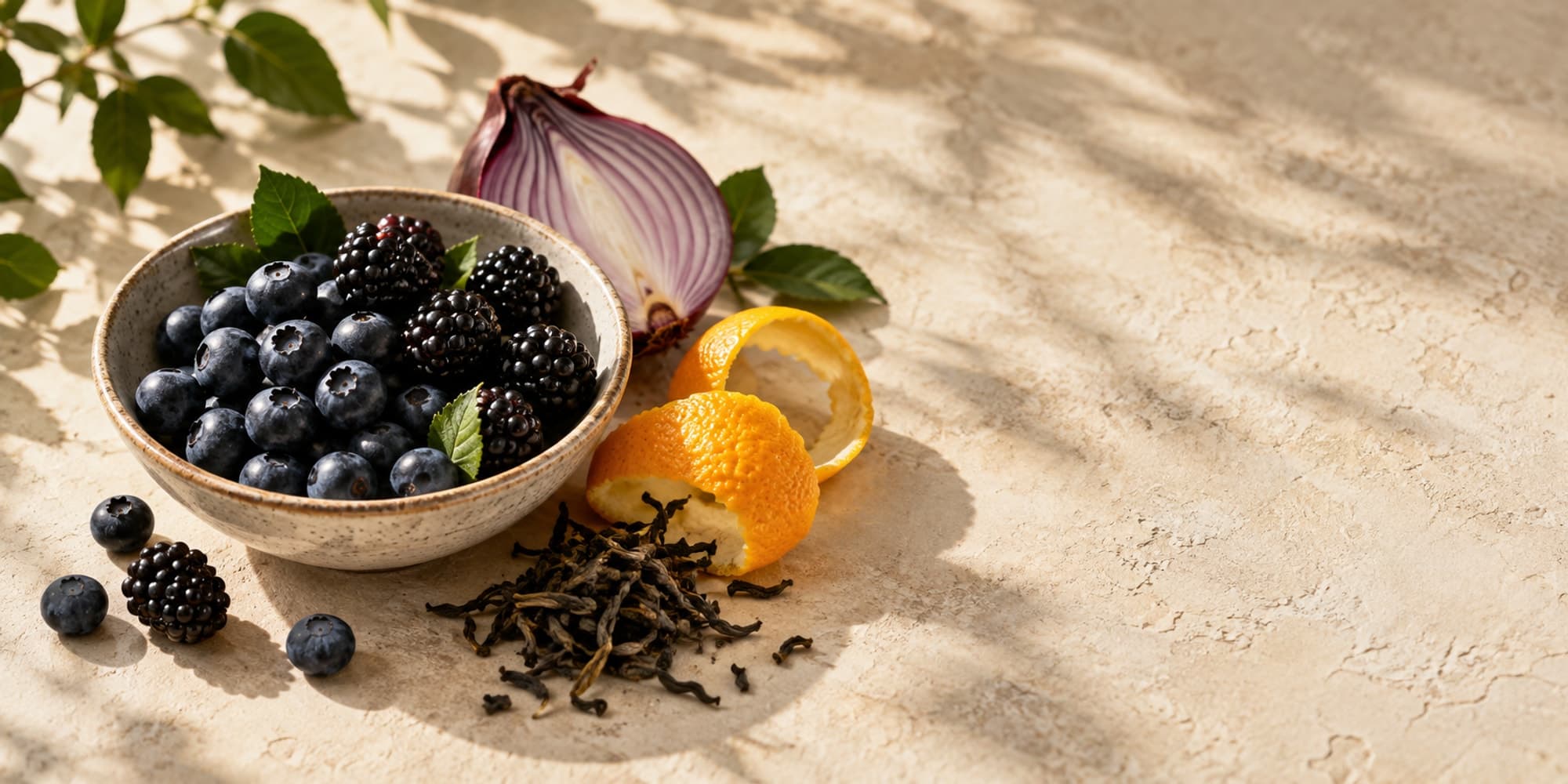
"Flavonoid" tells you what kind of compound you're looking at. "Antioxidant" tells you something that compound can do in a particular chemical test. One is a family name; the other is a job description.
That sounds like a vocabulary lesson, but it clears up a lot of bad label logic. Quercetin is a flavonoid. Vitamin C isn't. Both can act as antioxidants under the right conditions, and neither word by itself tells you whether eating or swallowing more will improve your health.
The distinction in one line
Flavonoid is a family. Antioxidant is a function. Quercetin, luteolin, catechins, and anthocyanins belong to the flavonoid family because of their chemical structures. Calling them antioxidants describes how they behaved in a reaction.
Think of "citrus" and "sour." Citrus names a group of fruits. Sour describes a taste that citrus can have, but plenty of non-citrus foods taste sour too. The comparison isn't chemically exact, but it's a much better mental model than imagining two rival types of supplement.
The two labels answer different questions
What family does this plant compound belong to?
How did it behave in this chemical system?
Did a relevant human study find a meaningful result?
What counts as a flavonoid
Flavonoids are one large branch of the polyphenol family. They include flavonols such as quercetin, flavones such as luteolin, citrus flavanones, tea catechins, and the anthocyanins that help color blueberries and blackberries.
The names are annoyingly similar because the structures are related. You don't need to memorize the family tree to eat well. Onions, tea, citrus, cocoa, berries, apples, herbs, and leafy greens cover several branches without requiring you to calculate anything at the grocery store.
Not every polyphenol is a flavonoid. Coffee's chlorogenic acids, resveratrol from grape skins, and curcumin from turmeric sit elsewhere in the larger polyphenol family. Marketing may call all of them antioxidants, which is true in a narrow sense and not enough information to compare them.
A bowl of berries also contains water, fiber, sugars, vitamins, and many plant compounds at once. If a study finds that people who eat more fruit have different health outcomes, one anthocyanin can't claim the entire result.
| Question | What the evidence says | Practical meaning |
|---|---|---|
| Flavonoid | A chemical family of plant polyphenols | Names what the compound is |
| Antioxidant | A description of chemical behavior in a given system | Doesn't name one compound family |
| Food claim | Flavonoid-rich foods contain fiber and other nutrients | Laboratory antioxidant capacity doesn't establish a clinical benefit |
What antioxidant actually describes
Oxidation is a normal chemical process. An antioxidant can slow a particular oxidation reaction under the conditions of a test. Change the concentration, solvent, target molecule, or test method and the score can change too.
That's why ORAC, FRAP, and similar antioxidant-capacity numbers aren't universal rankings of healthy foods. The USDA removed its old ORAC database from public use after those values were repeatedly misused to market products. A huge test-tube number can still tell you very little about dinner.
Your body has its own antioxidant systems, and it transforms flavonoids during digestion and metabolism. The compound that reaches your blood may be present at a much lower concentration and in a different form from the one placed in the assay.
A test tube is the first question, not the last
Shows a reaction under controlled conditions.
Asks what is absorbed, changed, and cleared.
Tests whether something meaningful changes in people.
Where the terms overlap
Many flavonoids do show antioxidant activity in laboratory systems. The overlap is real. The mistake is treating the words as synonyms. Not every antioxidant is a flavonoid, and "antioxidant" doesn't tell you the compound, dose, food, or human outcome.
This is where front labels become slippery. "Contains flavonoids" at least identifies a broad family. "High in antioxidants" may refer to a laboratory score, or it may be a health halo with no useful quantity attached.
Turn the bottle around. A useful supplement label names the exact ingredient, amount per serving, serving count, and other active ingredients. Then the evidence has to match that form and dose. If the package gives you only a giant antioxidant number, it has told you almost nothing about what the product will do.
Common questions
Are all flavonoids antioxidants?
Many show antioxidant behavior in common assays, but the result depends on the test conditions. That label still doesn't tell you how the compound is absorbed or what it does in a person.
Does antioxidant activity prove a health benefit?
No. It proves activity in the test that was run. A health benefit needs appropriate human evidence using a defined food or compound, dose, population, comparison, and outcome.
Which foods contain flavonoids?
Tea, cocoa, berries, onions, citrus, herbs, apples, and leafy greens all contain flavonoids. Each brings a different mixture, plus other nutrients and often fiber. Variety is more useful than trying to crown one highest-flavonoid food from a database.
Are flavonols the same as flavonoids?
Flavonols are one branch of the larger flavonoid family. Quercetin is a flavonol; luteolin belongs to a different branch called flavones. The similar names describe related structures, not interchangeable compounds.
The practical takeaway
Use "flavonoid" for the compound family and "antioxidant" for the tested behavior. For food, that's enough taxonomy. Put onions in dinner, berries on breakfast, and tea or coffee in the mug because you like them, not because one won an assay.
Concentrated products need a stricter comparison. Match the exact ingredient and dose to human evidence, and read the food and supplement tradeoffs. Ordinary food exposure and a high-dose capsule aren't the same experiment, as this guide to getting too many polyphenols explains.