
Resveratrol Benefits: What the Human Trials Actually Found
Sep 9, 2026
You've got a resveratrol bottle in your hand, and the label makes it sound as if a little piece of red wine has been turned into a longevity pill. That's a tempting story. It's also missing the useful part. The human research gives us a few good reasons to stay interested, although it hasn't shown that people live longer. Trials have found improvements in blood vessel function, body weight and one marker of inflammation in certain groups. Other reviews found no benefit. If you're comparing resveratrol benefits and side effects before buying, this article sorts those results out, then gets into the dose, absorption, safety and whether a supplement makes sense for you.
Where the resveratrol story came from
Resveratrol had been sitting quietly in grape skins, peanuts and red wine long before it became supplement-aisle shorthand for healthy aging. Most capsules get their resveratrol from Japanese knotweed. The supplement became famous because of a 2006 mouse study.
That happened in 2006, when researchers fed mice a high-calorie diet and gave some of them resveratrol. The mice that got resveratrol lived longer. It's a real result, and it gave scientists a sensible reason to keep studying the compound.
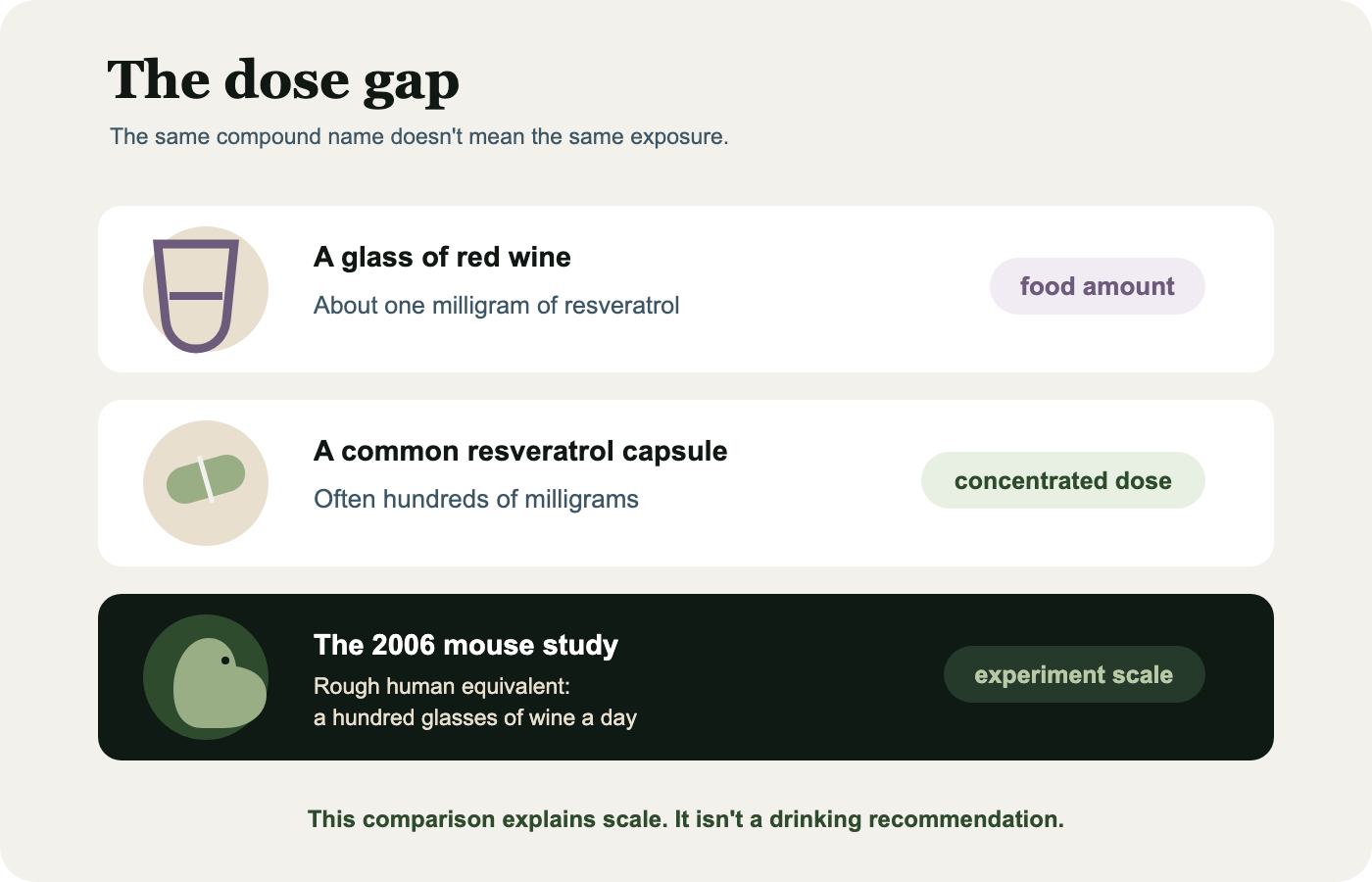
Then comes the detail that tends to disappear from the headline. The mice received roughly the human equivalent of a hundred glasses of red wine a day. No person could copy that experiment over dinner, and nobody should try. The number matters because it tells you that the study used a very large experimental dose in mice. It gave us no human evidence that wine or a capsule adds years to your life.
The mouse study gave researchers a starting point. They followed it with randomized human trials that measured blood vessel function, weight, inflammation and other health markers. Those studies can't answer the lifespan question, though they're much closer to the decision you're making in the aisle. Once you separate the mouse headline from the human data, resveratrol looks less magical and more practical: a supplement with some encouraging findings, some misses and plenty left to learn.
What the human trials found
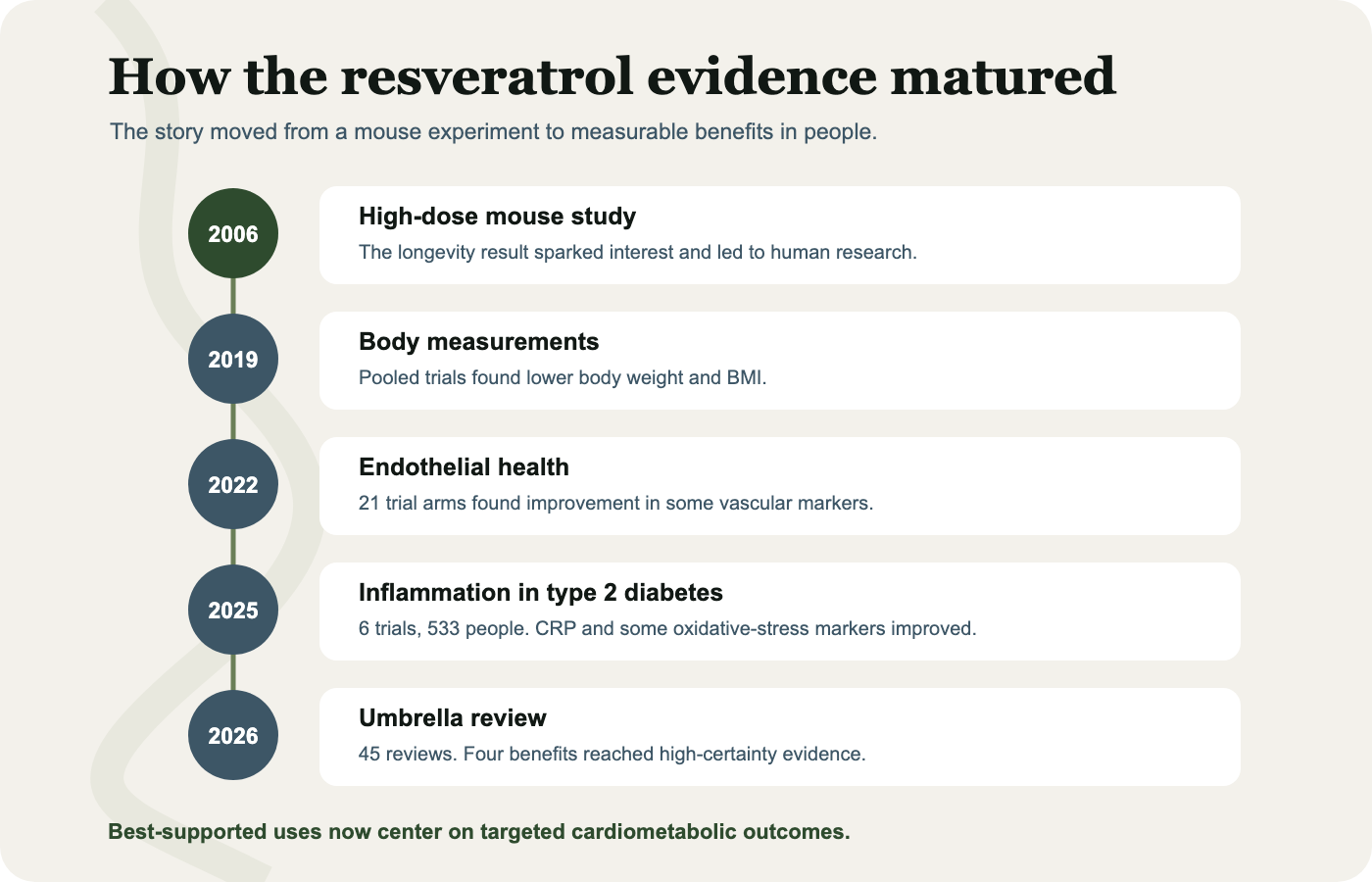
Three reviews give resveratrol a fair case for further use and research. A 2022 systematic review pooled 21 arms from 17 randomized trials and found improvements in markers of endothelial function. In plain English, the lining of the blood vessels appeared to work better. That's relevant to cardiovascular health, even though it doesn't tell us whether anyone avoided a heart attack.
A 2019 dose-response meta-analysis found lower body weight and BMI with resveratrol supplementation, but no meaningful change in fat mass. A 2020 meta-analysis of 6 trials and 491 people with type 2 diabetes found lower C-reactive protein, or CRP, which researchers use as a marker of inflammation.
If you're looking for a reason to consider a resveratrol supplement, these are the results I'd put at the top of the page. They came from randomized human trials and measured specific markers rather than vague ideas such as "cellular vitality." The trials were generally small and short, so they can spot a promising change while leaving years of use unanswered.
| Review | Year | What it pooled | What it found |
|---|---|---|---|
| Endothelial function | 2022 | 21 arms from 17 randomized trials | Improvement in endothelial markers |
| Obesity measures | 2019 | Randomized trials, dose-response | Lower body weight and BMI, no change in fat mass |
| C-reactive protein | 2020 | 6 trials, 491 people with type 2 diabetes | Lower CRP |
| Antioxidant supplements and mortality | 2012 | 78 trials, over 250000 people | No effect on how long people lived |
What they did not find
The positive findings deserve to be taken seriously. They also need to stay attached to what the researchers measured. Better endothelial markers aren't the same as fewer heart attacks. Lower CRP isn't the same as feeling less inflamed. A small change in body weight doesn't promise a visible change in the mirror.
Other reviews found no meaningful benefit, including analyses of bone quality and cardiovascular risk factors. That's why "mixed" is still the honest word. The studies ran for weeks or months, not years, and most were too small to answer the questions people care about most: whether resveratrol helps them stay well or live longer.
A broader 2012 Cochrane review pooled 78 randomized trials with more than a quarter of a million people and found that antioxidant supplements didn't help people live longer. That review wasn't a verdict on resveratrol alone. It does make the larger antioxidant-to-longevity leap harder to defend.
This is where internet searches can outrun the papers. Resveratrol benefits for skin, resveratrol benefits bodybuilding and resveratrol benefits testosterone all sound plausible if you start with a mechanism and work backward. The approved human evidence here doesn't establish those uses. The same goes for broad claims about resveratrol benefits for women or resveratrol benefits for men. Sex-specific marketing on the front of a bottle tells you less than the study population printed in the research.
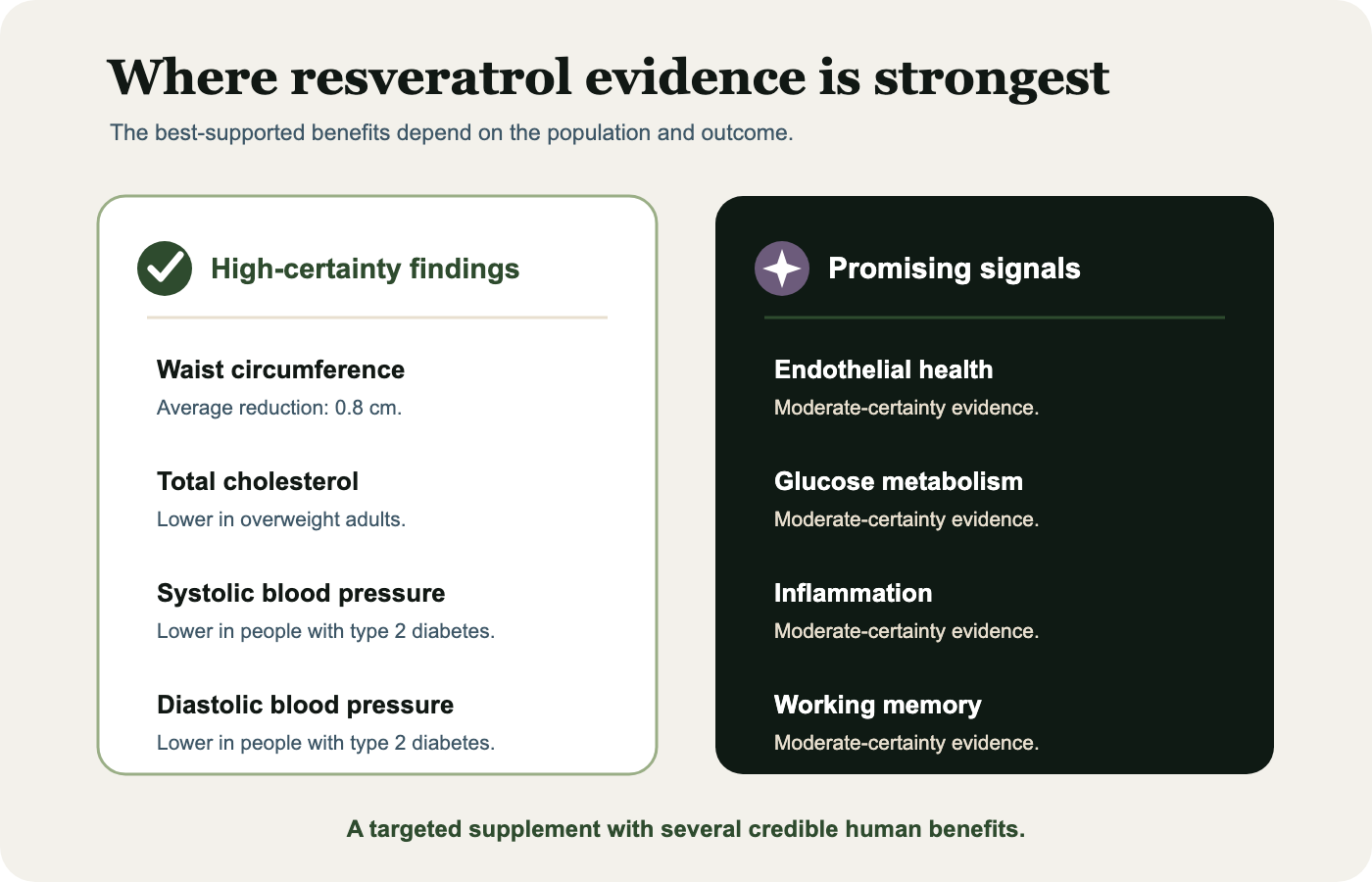
I'd call the human results promising but narrow. That's a better reason to consider resveratrol than the old mouse story, as long as the outcome you want is one the trials measured.
Wine, capsules and the dose problem
A glass of red wine contains on the order of a milligram of resveratrol. A capsule commonly contains hundreds of milligrams. Put the two side by side and the difference is obvious: a capsule gives you a concentrated dose that you won't get from a normal meal.
That concentration is also why supplements are useful in research. Scientists can give everyone a known amount without asking them to drink alcohol or somehow eat a shopping bag full of grapes. If a human trial found a benefit at a supplement dose, a capsule is the practical way to reproduce that exposure.
The bottle in your hand may list a plant extract, trans-resveratrol or both. Turn it around and find the amount of resveratrol per serving. Don't assume the large number on the front refers to the active compound. I'd also skip proprietary blends that hide how much of each ingredient you're getting.
Whole foods still belong in the picture. They bring fiber and other nutrients with them, while their resveratrol content varies with the plant, ripeness, storage and processing. Drinking more red wine to chase resveratrol benefits also brings more alcohol. If you want the dose used in a trial, use the trial and the Supplement Facts panel as your reference points.
Why absorption complicates all of it
You swallow the capsule, but the compound on the label doesn't simply arrive in your bloodstream unchanged. Resveratrol is absorbed poorly and metabolized quickly. Blood levels of the original compound stay low and fall fast after an oral dose.
Your digestive system and gut bacteria change polyphenols along the way. What circulates in your body after lunch, or after a capsule, isn't identical to what went into your mouth. That's normal biology, but it makes a simple milligram comparison less satisfying than supplement labels suggest.
This helps explain why trials use isolated resveratrol in amounts far above what a glass of wine supplies. Researchers need a controlled exposure before they can see whether a marker changes. It also explains why more isn't automatically better. A larger dose on a label doesn't guarantee that more unchanged resveratrol reaches the tissue you're hoping to affect.
I use the dose to match a product to a study. If a trial interests you, check how much resveratrol people took, who took it and how long the trial ran. Then compare those details with the bottle. A product that shouts "maximum strength" while hiding its actual resveratrol amount gives you very little to work with.
The positive human findings already include whatever happened during absorption and metabolism. We still can't assume that every dose, formula or food will produce the same result.
Is it worth taking?
For some people, yes. A resveratrol supplement is reasonable to consider if you're interested in one of the outcomes that human trials have measured, particularly endothelial function, body weight or CRP in people with type 2 diabetes. The evidence gives you more to go on than a mouse study or a longevity claim on a product page, although a noticeable effect is far from guaranteed.
Think of it as an optional experiment with a defined goal rather than insurance against aging. Decide what you're hoping to change before you order it. If you can't name that outcome, you won't have a useful way to judge whether the capsule earned a place in your routine.
Product quality matters. Look for a clear amount of resveratrol per serving and independent testing when you can find it. A transparent label is more useful than a long list of claims about energy, skin and hormones. Resveratrol benefits for skin remain less established than the human marker data reviewed above, and searches for resveratrol benefits for women often mix general supplement claims with research from specific populations.
Keep the supplement in proportion, too. NCCIH notes that diets higher in fruit and vegetables are associated with lower rates of chronic disease, while antioxidant supplements haven't reproduced that broad benefit. Whole foods come with fiber and other nutrients. A capsule gives you a concentrated, repeatable dose. You can value both for different reasons.
My verdict is cautiously positive: resveratrol may be worth a monitored trial when the research matches your goal. It hasn't earned the status of a general longevity supplement.
Who should be careful
If you take blood-thinning medication, talk to your doctor or pharmacist before starting resveratrol. That's the clearest interaction concern in this brief, and it matters more with a concentrated supplement than with the small amount in food.
Bring the actual bottle to that conversation. Your clinician needs the serving size, the source of the resveratrol and the full ingredient list. "It's a red wine antioxidant" leaves out the part that matters: the capsule may contain hundreds of times the amount you'd get from a glass.
NCCIH also cautions that large amounts of antioxidants may interfere with important functions in the body. A normal supplement dose isn't automatically harmful, though the usual "more is better" logic doesn't hold up here. A high dose can add uncertainty without adding a proven benefit.
If you're pregnant, breastfeeding, preparing for surgery or managing a health condition, ask your doctor or pharmacist about the product before you use it. Do the same if you take prescription medication. That conversation should check whether the product and dose fit with the rest of your care.
When you're weighing resveratrol benefits and side effects, remember that the trials mostly tracked health markers over a short period. They don't give us a complete picture of long-term use. Side-effect reporting can also vary from one trial to the next. That uncertainty calls for attention rather than an automatic yes or no.
How to read the next resveratrol headline
Open the study before trusting the headline. Was it done in people, mice or cells? If people took the supplement, check how many were in the trial and how long it lasted. A small study over a few weeks can find an interesting signal, though it can't settle what happens over years.
Next, look at who participated. Results in people with type 2 diabetes can't be pasted onto every healthy adult. A headline about resveratrol benefits for women should tell you which women were studied and what changed. The same standard applies to resveratrol benefits for men. Broad labels hide the details you need.
Then check the outcome. Blood pressure, CRP, weight and endothelial function are measurable, but they aren't interchangeable. A study showing that one marker moved doesn't support every benefit printed on a label. If you're interested in resveratrol benefits testosterone, for example, a CRP trial can't answer your question.
Dose comes last. Compare the amount used in the study with the amount in one serving, then look at the source and formulation. Don't use a wine estimate to judge a capsule trial. They're different exposures.
Here's the sentence I use: match the people, dose, trial length and outcome to the claim you're being asked to believe. If those pieces line up, the finding may be relevant to you. If they don't, the headline is doing more work than the research.
Our page on what the research supports explains how we grade this kind of evidence across the site. For resveratrol, the positive marker findings are worth following. The longevity promise still needs human proof.
Common questions
What are the negative side effects of resveratrol?
The approved evidence doesn't provide a complete side-effect rate. The main practical concern is an interaction with blood-thinning medication, especially at supplement doses far above food. If you take medication or have a health condition, show the exact product and serving size to your doctor or pharmacist before starting it.
What should you not mix with resveratrol?
Don't combine resveratrol with blood-thinning medication without talking to your doctor or pharmacist. Bring the bottle, since the amount and other ingredients matter. This warning applies to concentrated supplements, not the ordinary amount you'd get from grapes or peanuts. Your clinician can judge the combination in the context of your care.
What foods are high in resveratrol?
Resveratrol foods include grape skins, red wine and peanuts. Japanese knotweed contains it too and supplies much of the material used in supplements. Food amounts vary with the plant variety, ripeness, growing conditions, storage and processing, so any number in a database is an average rather than a measurement of your meal.
Can I take resveratrol and magnesium together?
The evidence in this brief doesn't establish whether that combination is safe for you. The answer depends on the doses, the products, your medications and your health. Ask your doctor or pharmacist about both labels rather than relying on a general interaction list, especially if either supplement is part of a larger blend.
How much resveratrol is in a glass of red wine?
A glass of red wine provides on the order of a milligram of resveratrol, while capsules commonly provide hundreds of milligrams. Wine amounts vary, so that figure is an estimate. Drinking more wine isn't a sensible way to copy a supplement trial, and the alcohol carries risks that a resveratrol capsule doesn't.
Is resveratrol worth taking as a supplement?
It may be, if your goal matches a result from a human trial and your doctor or pharmacist sees no conflict with your care. Evidence for endothelial function, body weight and CRP is encouraging. Evidence that resveratrol helps people live longer isn't there yet, so I'd skip products sold mainly on a longevity promise.
So should you take it?
Resveratrol is optional, with a few encouraging findings from human trials. A standardized supplement is the practical way to reach the amounts researchers used. If one of those measured outcomes matters to you, the product may be worth discussing with your doctor or pharmacist. Choose a transparent label, set a specific goal and keep a varied, plant-heavy diet doing the broader work.