Quercetin Supplement Benefits: What the Trials Measured
Sep 9, 2026
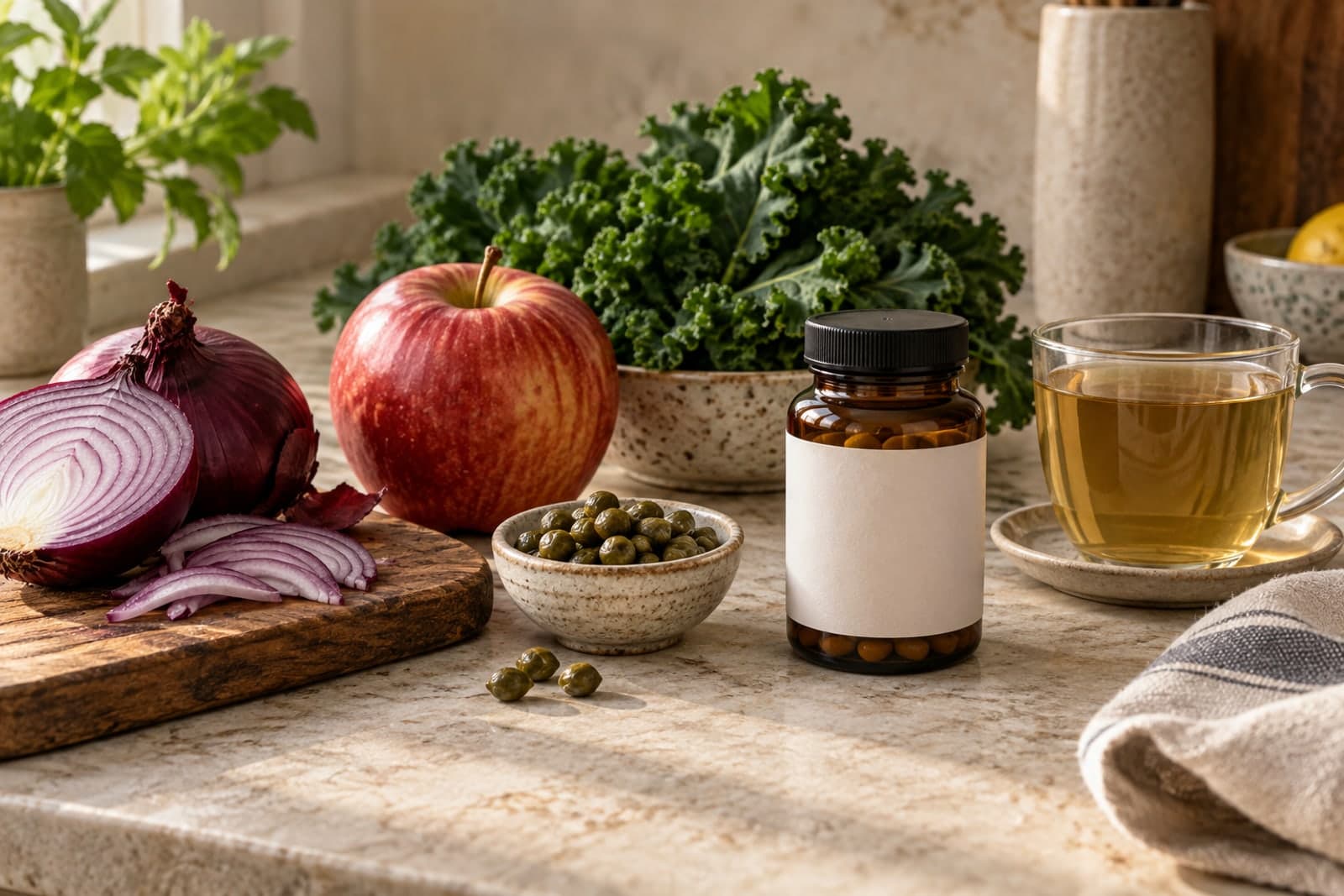
You're holding a quercetin capsule because the label mentions allergies, immunity or both. The front makes the decision feel simple. The research doesn't. Quercetin supplement benefits have mostly been studied through changes in blood pressure and inflammatory proteins, not through questions such as whether people caught fewer colds or noticed their allergies easing. The trials are generally small and short, and the dose in the bottle is far above what you'd eat in a normal day. There may be a reason to use the supplement, but first you need to know what was measured, what wasn't and whether an onion gets you closer to your actual goal.
What quercetin is, and where you already eat it
Quercetin is a flavonoid, one member of the larger polyphenol family. You don't need a specialty shop to find it. Red onions, apples, capers, kale and tea all contain it. Red onions are one of the more concentrated everyday sources, especially in the outer layers you peel away when the skin looks dry or bruised.
I notice the tradeoff every time I cut an onion. The papery skin has to go, but I try not to strip off several good purple layers with it. Cooking changes the amount of quercetin that reaches your plate, so a database figure for a raw onion won't describe every bowl of soup. Apples present a similar problem because much of their quercetin sits in the skin.
Capers can look impressive in a per-gram table, though a spoonful on a salad is still a small serving. Kale adds quercetin alongside other flavonoids. Tea gives you a brewed source whose final content depends on the leaf and how long you steep it.
That variation isn't a flaw. It's what food looks like. Cultivar, ripeness, growing conditions, storage and processing all change polyphenol content. A composition database gives you an average, not a lab reading of the onion in your cart. The supplement offers a fixed amount. Food offers quercetin as part of lunch.
| Food | Where it sits | What changes it |
|---|---|---|
| Red onions | Concentrated in the outer layers | Cooking method |
| Apples | Mostly in the skin | Peeling removes most of it |
| Capers | Throughout, high per gram | Serving size is small |
| Kale | Leaves | Also carries other flavonoids |
| Tea | The brewed leaf | Steep time and leaf quality |
What the trials measured
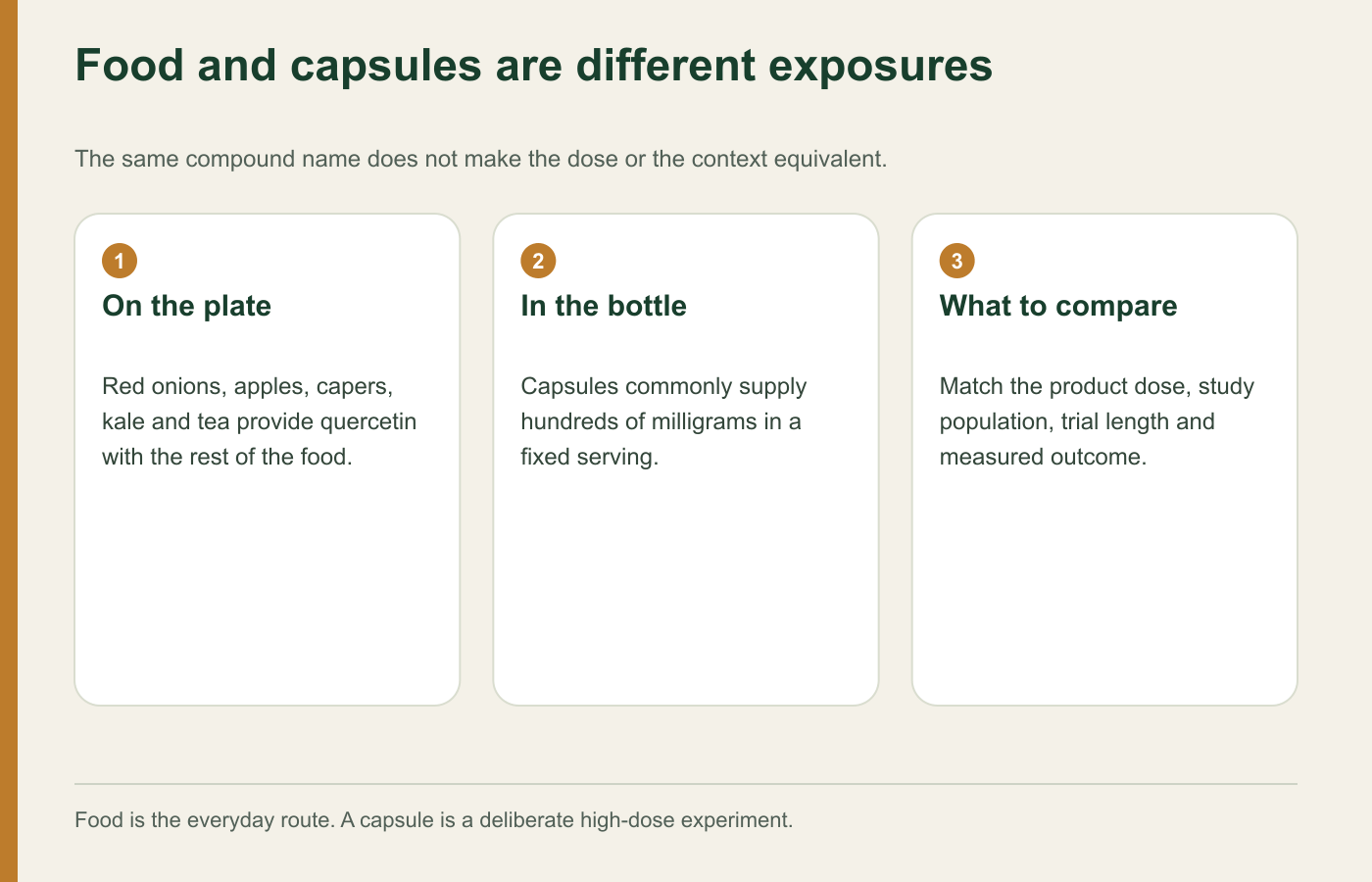
Most quercetin trials have asked whether a marker changed. Researchers have measured things such as blood pressure and inflammatory proteins before and after people took a supplement. A marker can tell us that something happened in the body. It can't always tell us whether the person felt better, stayed healthier or would benefit after years of taking the product.
That distinction matters because supplement labels tend to turn a change in one marker into a much larger promise. If an inflammatory protein moves, the front of the bottle may say "immune support." If blood pressure shifts, the product page may start talking about cardiovascular health. The trial and the marketing aren't necessarily answering the same question.
The human trials are usually small and last for weeks rather than years. That doesn't make them useless. Short studies are a reasonable way to see whether a compound changes a measurable signal. They're much weaker at telling us whether the change lasts or leads to an outcome you'd notice.
I read these studies with one question in mind: what did the researchers count? If they counted a lab value, I keep the conclusion at the level of that lab value. I don't turn it into fewer sick days or easier spring allergies unless the trial measured those things.
This is the less exciting version of quercetin supplement benefits, but it's the one that helps you shop. There are human data worth following. The evidence just doesn't support every promise that has accumulated around the ingredient.
The dose problem
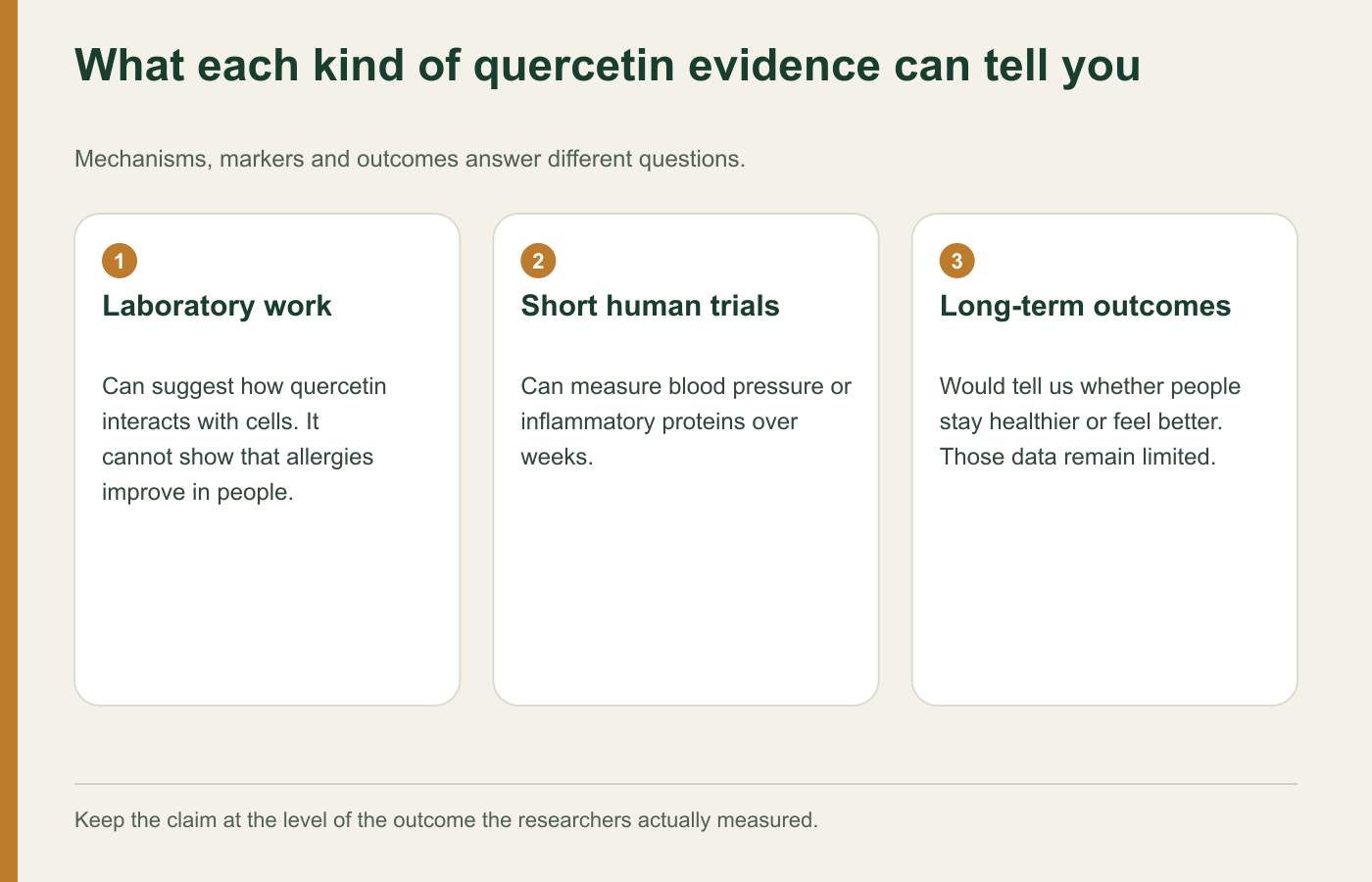
A quercetin capsule commonly supplies hundreds of milligrams. A normal day of eating supplies far less. You'd need an unrealistic amount of onions, apples or capers to copy a concentrated supplement dose. Food serves a different purpose.
The gap cuts both ways. A positive supplement trial can't be used to claim that one red onion will reproduce the result. A long history of eating onions also can't prove that a concentrated capsule will behave like food. Same compound, very different exposure.
You may be thinking that the bigger number must be the better option. A larger amount gives researchers a clearer test while moving the product farther away from the conditions under which people normally encounter quercetin. NCCIH notes that large amounts of antioxidants may interfere with important functions in the body. Higher doses can add uncertainty without adding benefit.
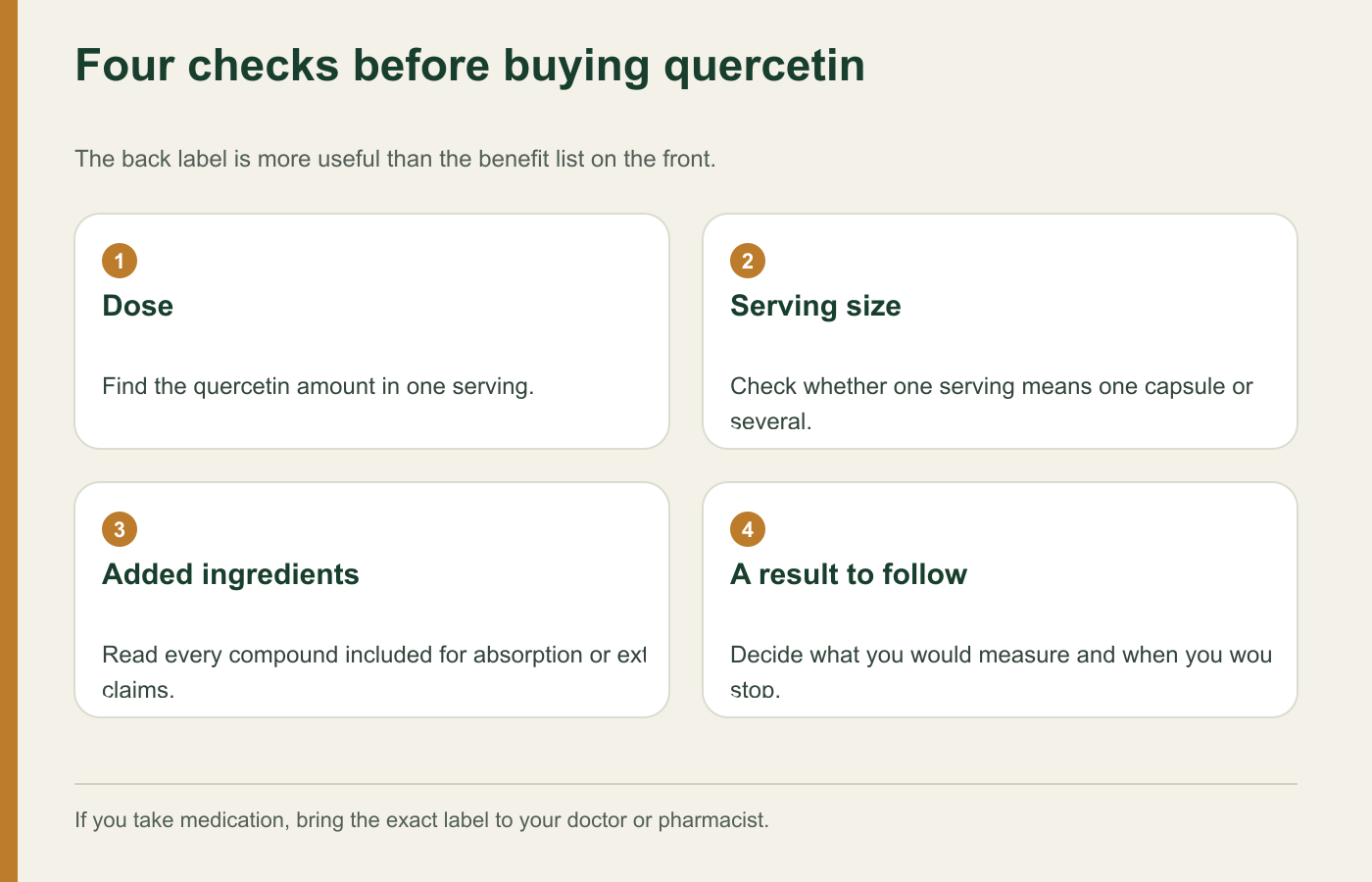
Turn the bottle around and read the Supplement Facts panel. Look for the amount of quercetin in one serving, then check whether that serving means one capsule or several. If a claim points to research, see whether the dose on the label resembles the dose in that research. Even a close match can't guarantee the same result. A large mismatch makes the citation much less useful.
Food and capsules answer different needs. Food is the steady, low-dose route. A supplement is a deliberate high-dose experiment.
Absorption, and why formulas add other ingredients
Quercetin on its own is poorly absorbed. Digestion changes it, gut bacteria work on it and only part of what you swallow reaches the bloodstream in the form you may expect. That's one reason a capsule can contain a large amount without producing equally large blood levels.
Supplement companies often add another ingredient and say it improves uptake. The logic is understandable: if absorption is the bottleneck, pair quercetin with something intended to help it cross that bottleneck. The problem is that a more complicated formula gives you more questions to answer.
First, does the added ingredient improve absorption in people? Then, does that extra absorption improve the outcome you care about? Those aren't the same test. A higher blood level proves that more reached the blood. It doesn't prove that you felt better or got sick less often.
Combination products also make it harder to know what did what. If a formula contains quercetin plus several other compounds and a marker changes, you can't confidently hand all the credit to quercetin. I prefer a label that tells me the amount of every ingredient and makes a modest claim I can trace back to a study.
This doesn't mean absorption-focused formulas are pointless. Poor uptake is a real formulation problem. It means you should judge the delivery claim and the health claim separately. A clever capsule can deliver quercetin well while the underlying evidence for a particular benefit remains thin.
Allergies and immunity: where that claim comes from
The allergy and immunity story comes largely from laboratory work. In cell culture and other test-tube settings, researchers can expose cells to quercetin and watch particular pathways or signals change. That work can suggest a mechanism. Human trials still have to show whether a person with seasonal allergies will sneeze less after taking a capsule.
Human immune systems aren't dishes of isolated cells. Digestion changes quercetin before it reaches the bloodstream, doses vary and real people have medications, diets and health histories that a lab setup doesn't reproduce. The distance between a cellular effect and a useful daily result can be large.
That's the part many labels skip. "Supports immune health" sounds as if researchers counted colds or measured how quickly people recovered. The approved evidence behind this brief says most human trials focused on markers, while the allergy and immunity claims lean heavily on lab research.
I wouldn't call the mechanism meaningless. Lab work is where many good questions begin. I'd call it unfinished. A useful allergy trial would need people with the relevant symptoms, a clear dose, a control group and an outcome they could actually notice. Until that evidence exists, the capsule's allergy pitch is ahead of the human data.
If allergies are why you're considering quercetin, don't substitute the supplement for care that already works for you. Ask your doctor or pharmacist how it fits with your medications and what result would make the experiment worth continuing.
Is a supplement worth it?
For most people shopping on the promise of allergy relief or stronger immunity, I'd start with food and save the money. The human trials haven't established those advertised outcomes. Red onions, apples, kale, capers and tea let you eat quercetin as part of a diet that brings fiber and other plant compounds too.
A supplement can still make sense if you have a specific marker in mind and have found a human trial that resembles you. In that case, match the dose, duration and outcome instead of buying the largest number on the shelf. Give the experiment a stopping point. If you can't say what you're measuring, it becomes very easy to keep paying for a bottle out of habit.
The wider evidence on antioxidant pills deserves some weight. A 2012 Cochrane review pooled 78 randomized trials and found no improvement in lifespan from antioxidant supplements overall. The review covered antioxidants broadly and warns against turning an antioxidant label into a promise of broad protection.
Quercetin is sold as a dietary supplement in the United States, so regulators don't review it for effectiveness before sale. Look for a transparent dose and independent testing. Our archive of supplements we've looked at uses the same rule: the outcome data matter more than the theory on the label.
My verdict is simple. Food is the better default. A capsule is a targeted choice, not a nutritional upgrade.
Who should be careful
If you take prescription medication, talk to your doctor or pharmacist before starting quercetin. Bring the bottle or a clear photo of the Supplement Facts panel. The amount per serving and the other ingredients matter more than the word "natural" on the front.
That conversation is especially useful with a combination formula. A product sold as quercetin may include several ingredients intended to change absorption or add another benefit. Show your clinician the whole list, including the added ingredients.
NCCIH's broader antioxidant guidance is worth keeping in mind. Large antioxidant doses may interfere with normal functions, and high doses of vitamin E have been linked with a higher risk of bleeding. That finding applies to vitamin E rather than quercetin. It still shows why the supplement aisle isn't a guarantee of safety for every concentrated antioxidant.
Daily use also deserves more caution than a short trial. Most quercetin studies ran for weeks. They can't give you a confident answer about years of continuous use. If you decide to try the supplement, agree on a dose, a reason and a review point with your doctor or pharmacist.
Don't use quercetin as a substitute for prescribed care. If the goal is allergy control, blood pressure or another health concern, the supplement should sit inside the plan you already have, not quietly replace it.
How to get more from food instead
You don't need to calculate quercetin milligrams at every meal. Build a week around foods that carry it and let the rest of the diet do useful work too. Keep red onions in the vegetable drawer, leave the skin on apples and use kale where you'd normally reach for another leafy green.
My easy version looks like this: sliced apple with breakfast, red onion folded into lunch, and a spoonful of capers over fish or beans at dinner. Tea covers another day without turning the kitchen into a supplement schedule. The point isn't to force every source into every meal. It's to make the foods ordinary enough that you keep eating them.
Cooking changes onion quercetin. You can still use both raw and cooked onion. Add a little raw red onion to a sandwich when it works, then roast or sauté the rest because vegetables you enjoy are vegetables you'll finish.
Food amounts vary, and you won't reach capsule-level doses this way. That's fine. Polyphenol-rich foods come with fiber and other nutrients, while a concentrated pill isolates one compound. NCCIH notes that higher fruit and vegetable intake is associated with lower rates of chronic disease, while antioxidant supplements haven't shown the same broad benefit.
If a convincing human trial eventually shows a clear reason to use high-dose quercetin, the supplement decision changes. Until then, the grocery route is cheaper and better supported.
Common questions
What are the downsides of taking quercetin?
Quercetin supplements deliver far more than you'd normally eat, long-term evidence is limited and combination formulas can complicate interactions. The United States doesn't review supplements for effectiveness before sale. If you take prescription medication, talk to your doctor or pharmacist about the exact product and serving size before starting it.
What to avoid when taking quercetin?
Avoid assuming that more is better or that a blend is safer because its ingredients come from plants. Don't replace prescribed care with quercetin. If you use medication, ask your doctor or pharmacist to review the full ingredient panel, since the added absorption ingredients may matter as much as the quercetin.
Is it okay to take quercetin every day?
Human trials have usually lasted weeks rather than years, so they can't settle the safety or value of long-term daily use. A clinician who knows your medications and health can give more useful guidance. If you try it, choose a clear goal and a date to reassess rather than taking it indefinitely.
Which is better, CoQ10 or quercetin?
They aren't interchangeable, and the brief doesn't provide enough evidence to rank them. Start with the outcome you care about, then look for human trials of that ingredient in a similar population. Don't choose by the longer benefit list. Ask your doctor or pharmacist if either product may conflict with your medications.
Is it better to get quercetin from food or a supplement?
Food is the better default for most people. Onions, apples, capers, kale and tea provide quercetin alongside fiber and other nutrients. A supplement gives a much larger, repeatable dose, which may make sense for a specific evidence-based goal. Keep those foods in your diet if you decide to try a capsule.
How much quercetin is in a red onion?
The brief doesn't approve one fixed number because onion content changes with variety, growing conditions, storage and cooking. Red onions are among the more concentrated everyday sources, especially in their outer layers. A food database gives an average for a raw sample, not a measurement of the onion on your cutting board.
What I would do
I'd put the capsule back if the pitch is allergies, immunity or vague "antioxidant support." The human evidence doesn't yet earn that purchase. I'd buy red onions, apples and tea, then keep an eye on trials that measure outcomes people can feel. If you and your doctor have a specific marker to follow, a transparent quercetin product may be a reasonable experiment. That narrower use is where the supplement starts to make sense.