
Liquid Antioxidant Supplements: Format Is Not the Question
Sep 17, 2026

A liquid antioxidant supplement and a capsule with the same formula deliver the same compounds. The liquid bottle changes how you swallow and measure the serving. It doesn't settle whether the ingredients help, whether the dose fits you, or whether the “better absorption” line has a meaningful comparison behind it. Before paying extra in the supplement aisle, turn both packages around and compare the ingredient, form, serving size, added ingredients, and evidence.
What the format actually changes
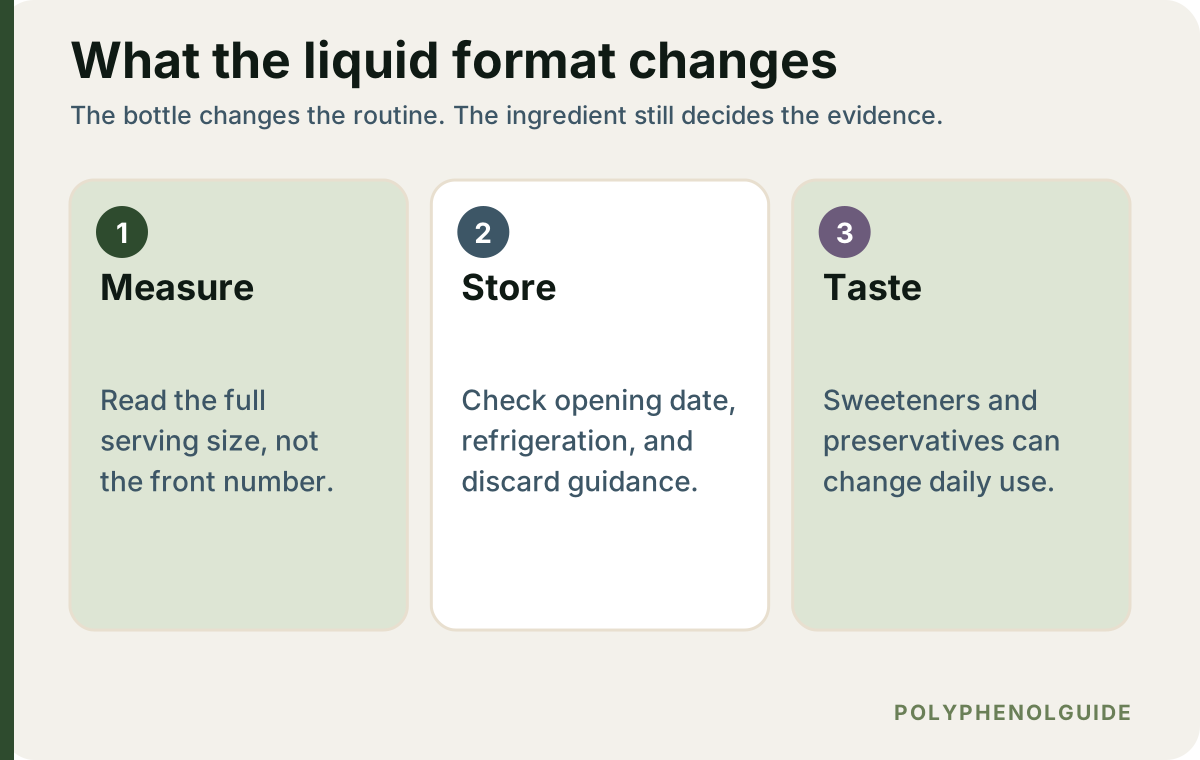
Format changes the measuring job more than the formula. A capsule arrives as a fixed unit. A liquid usually asks you to fill a cap or measuring spoon, sometimes to a line that's hard to see when the kitchen light is low. A slightly generous pour changes the dose. Check whether the serving is one full cap, half a cap, or several spoonfuls, and use the marked measure that came with the bottle.
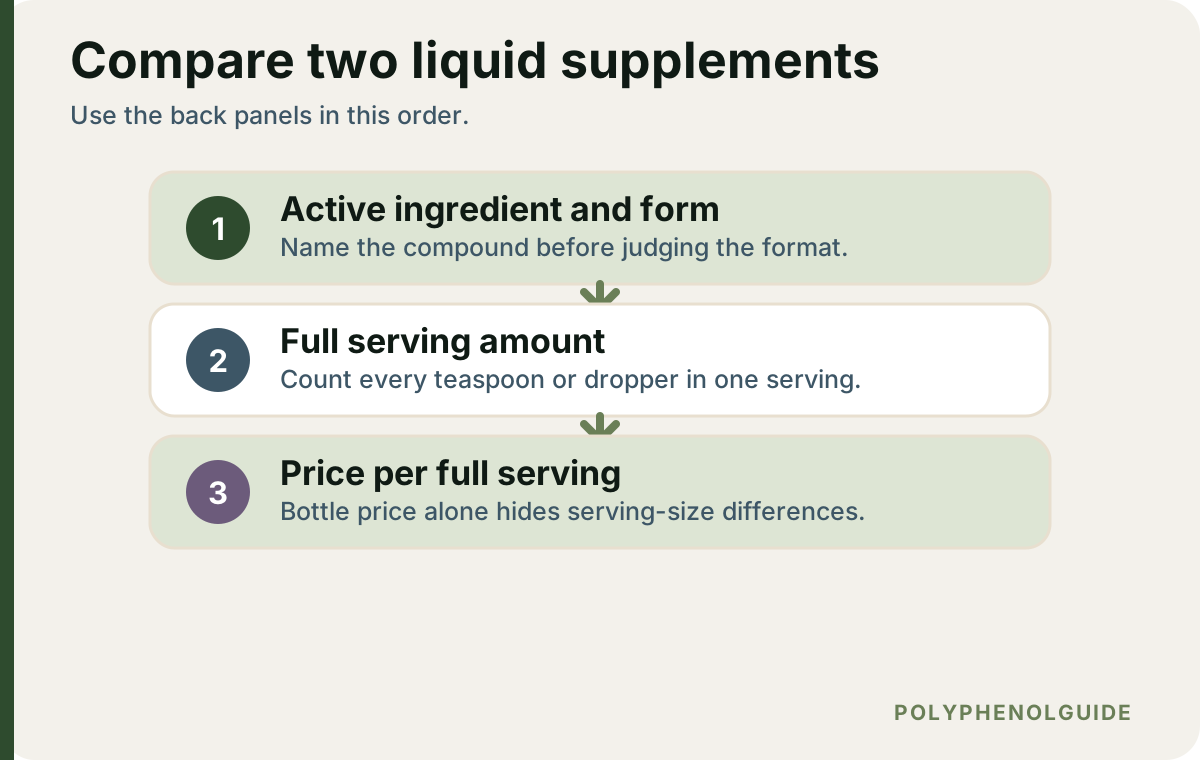
Liquid products also need ingredients that a dry capsule may skip. Read past the active compounds for sweeteners, flavorings, and preservatives. Those additions aren't automatically a problem, but they may affect taste, allergies, price, or whether you'll take the product consistently. “Absorbs better” needs another question: better than which capsule, carrying which form, at which dose? If the label doesn't answer, the claim gives you little to compare. The back panel deserves more attention than the front.
| Liquid | Capsule | |
|---|---|---|
| Compounds delivered | The same as the equivalent capsule | The same as the equivalent liquid |
| How the dose is measured | A spoon or cap the reader fills each time | Fixed per capsule |
| Other ingredients | Often sweeteners, flavorings, or preservatives | Usually fewer added ingredients |
| Absorption claims | Commonly made, rarely stating the comparison | Rarely made |
| What the reviews assess | The compounds, not the format | The compounds, not the format |
| What decides the risk | The compound and the dose | The compound and the dose |
What the reviews assess, which is not format
Large evidence reviews focus on the antioxidant compounds and their doses. The National Center for Complementary and Integrative Health says current evidence doesn't support antioxidant supplements for cancer prevention. It also warns that large amounts can interfere with normal cell signaling and defense mechanisms. High-dose beta-carotene has been linked to higher lung cancer risk, especially among smokers and people with occupational asbestos exposure. High-dose vitamin E has been linked to bleeding risk.
A 2012 Cochrane review pooled 78 randomized trials with more than a quarter million participants. It found no significant mortality benefit overall, while beta-carotene and vitamin E appeared to increase mortality. The authors argued that antioxidant supplements should be evaluated like medicinal products before marketing. The trials examined compounds, not the shape of the container. Pouring the same formulation from a bottle wouldn't change that result. Check the evidence for the actual ingredients before paying for a format claim.
The liquids that already do this
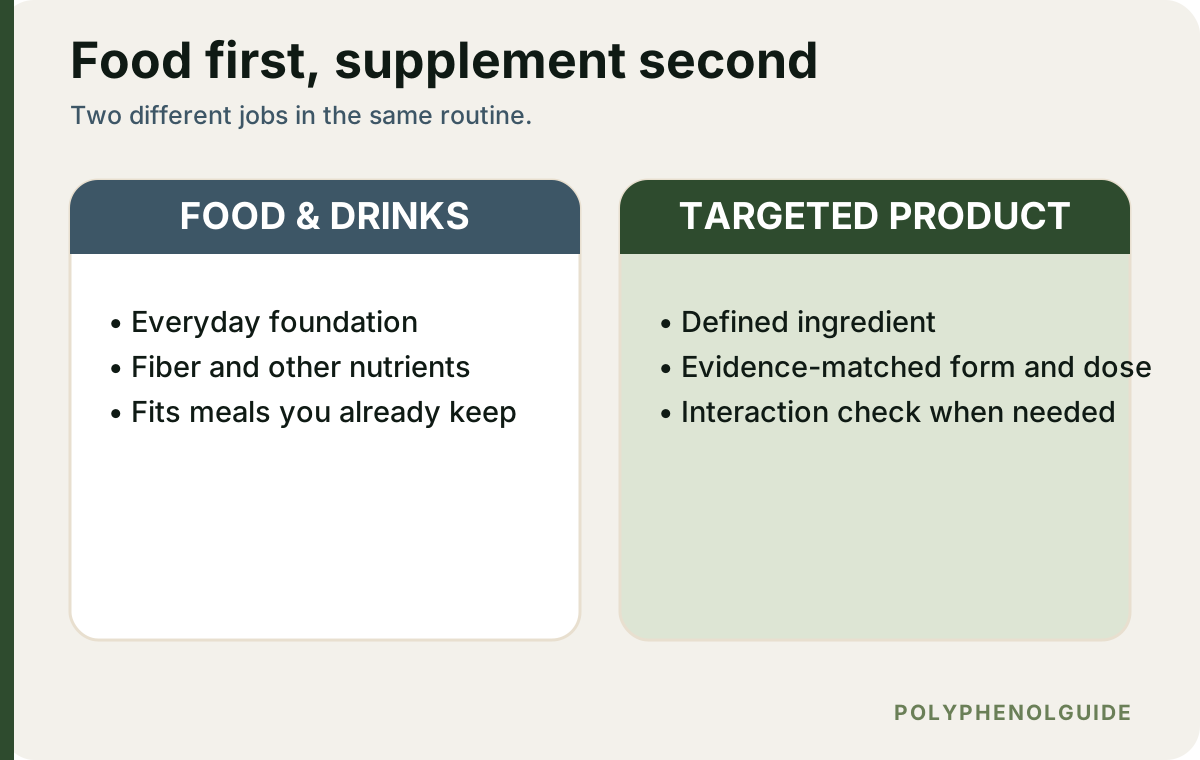
Food and drinks are the foundation. They bring antioxidant compounds with fiber or other nutrients, and they already fit routines many people keep. Start with the drinks already in your mug and the plant foods already in your cart.
- Keep drinking the unsweetened coffee or tea you already make at breakfast.
- Steep a tea bag in the mug on your desk instead of buying a sweetened wellness drink.
- Blend the frozen berries already in your freezer with breakfast.
- Choose a small bottle of unsweetened cocoa or tea only if you'll finish it before it goes stale.
- Pour water first when thirst is the reason you're reaching for a drink.
- Add a targeted, standardized supplement only when its ingredient, form, dose, and purpose match supportive human evidence.
Before you start one
Talk to a doctor or pharmacist before starting a liquid antioxidant supplement if you take prescription medication, are pregnant, or are being treated for a health condition. The compound and dose create the interaction question. The bottle format doesn't remove it.
Bring the bottle or a clear photo of the Supplement Facts panel. Include the serving size and every active ingredient, since a blend may repeat beta-carotene, vitamin E, or another compound that's already present in a multivitamin. The NCCIH risk signals involve high doses, and a measured liquid puts part of the dosing job in your hand. Use the supplied spoon or cap, read the fill line at eye level, and wash it after each serving. A standardized liquid may be useful when swallowing capsules is difficult or when a supported use calls for a measured dose. Convenience is a fair reason to choose it. “Liquid” alone isn't evidence that the product works better.
What we still don't know
Absorption can vary with the compound, preparation, dose, and person. Broad antioxidant reviews don't compare every liquid with its capsule twin, so they can't close every format question. A company making a better-absorption claim should name the comparison and show the human data. Until then, how much of the premium pays for a useful delivery option, and how much pays for the bottle?
Common questions about liquid antioxidant supplements
Which form of antioxidant is the best?
No delivery format is best across every antioxidant. Compare the compound, chemical form, amount per serving, human evidence, and your own ability to take it consistently. A liquid can help someone who struggles with capsules, but the bottle alone doesn't show better absorption or a better health result.
Do antioxidant supplements actually work?
Broad antioxidant supplements haven't shown a general mortality benefit in pooled randomized trials. The Cochrane review also found risk signals for beta-carotene and vitamin E. A targeted supplement may still be useful when a specific form, dose, and purpose have supportive human evidence. Format doesn't replace that evidence.
What is the most powerful antioxidant supplement?
“Powerful” isn't a useful ranking from the evidence reviews. A larger laboratory antioxidant score doesn't establish a better result in people, and a higher dose may add risk. Start with antioxidant-rich food and drinks. Consider a standardized supplement only for a defined goal supported by human evidence.
What is the best antioxidant supplement?
The reviews don't identify one best antioxidant supplement for general health. Read each product by ingredient, form, dose, and evidence. Food is the starting point. If you're considering a supplement for a specific gap or goal, ask a doctor or pharmacist whether that exact product fits your medications and health history.
What should I look for on a liquid supplement label?
Check the active ingredients, chemical forms, amount per serving, serving size, and added sweeteners, flavorings, or preservatives. Find the measuring line on the cap or spoon before buying. The serving size decides what every dose figure means, and a vague absorption claim should name its comparison.
Are liquid antioxidant supplements worth the money?
A liquid may be worth paying for when it's easier to swallow or measure for a supported use. The pooled trials don't show a general mortality benefit from broad antioxidant supplementation, and changing a capsule into a liquid doesn't alter that finding. Compare the formula and dose before comparing the price.