
How to Read a Curcumin Supplement Label
Sep 17, 2026

A high quality curcumin supplement should tell you four useful things on the back label: how much curcuminoid extract it contains, which absorption strategy it uses, the serving size, and whether an outside laboratory verified the contents. The gold bottle, oversized “premium” type, and turmeric root illustration don't answer those questions. Put two bottles side by side on the store shelf and read the small print before comparing prices.
Turmeric, curcuminoids and curcumin
Turmeric is the plant and cooking spice. Curcuminoids are a group of compounds in turmeric, and curcumin is the best-known member. Curcumin is also a polyphenol. Turmeric root contains only a small proportion of curcuminoids by weight, so supplement makers use concentrated extracts when they want to provide a stated amount.
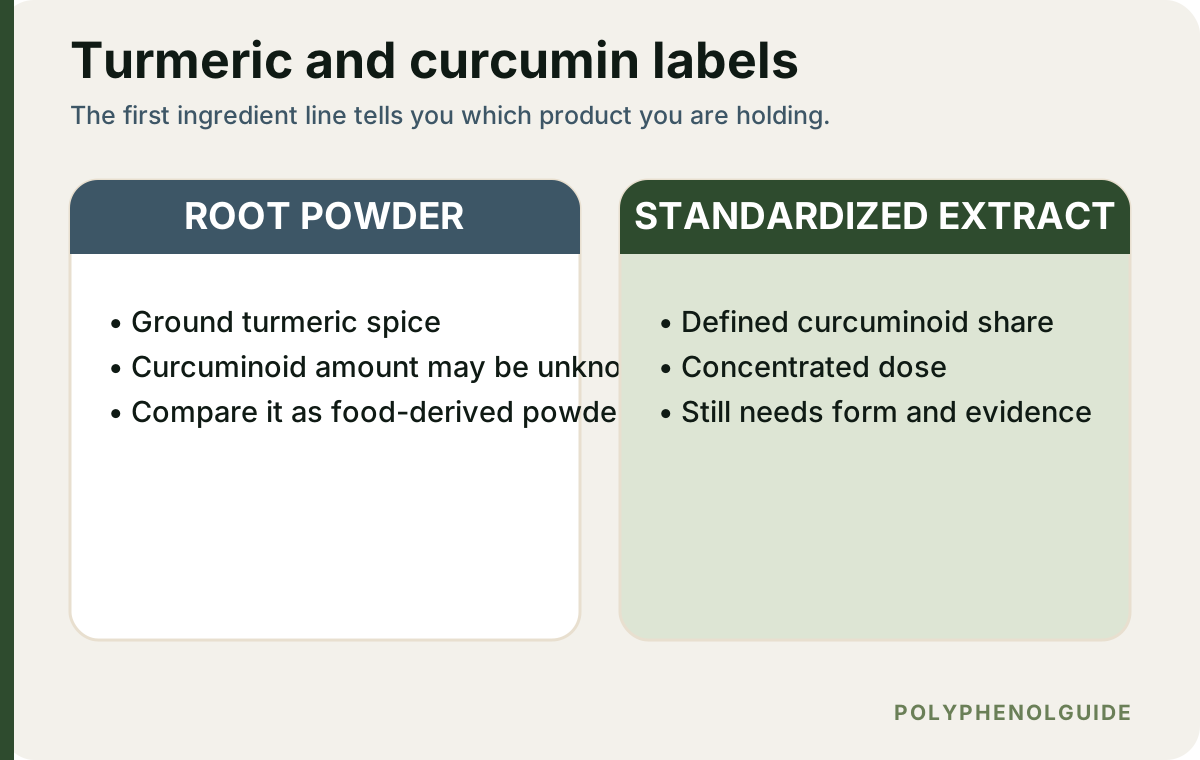
That distinction changes what you're buying. A label that lists only turmeric root powder describes ground spice in a capsule. A label that lists a standardized curcuminoid extract tells you how much of the active group the extract carries. “Standardized to 95 percent curcuminoids” is common on these products. It still doesn't tell you everything about absorption or results, but it gives you a defined ingredient to compare across bottles. In the kitchen, turmeric belongs in a pan with food. In a supplement aisle, the concentrated extract and its full listed dose deserve a separate safety check before purchase.
The problem every formulation is solving
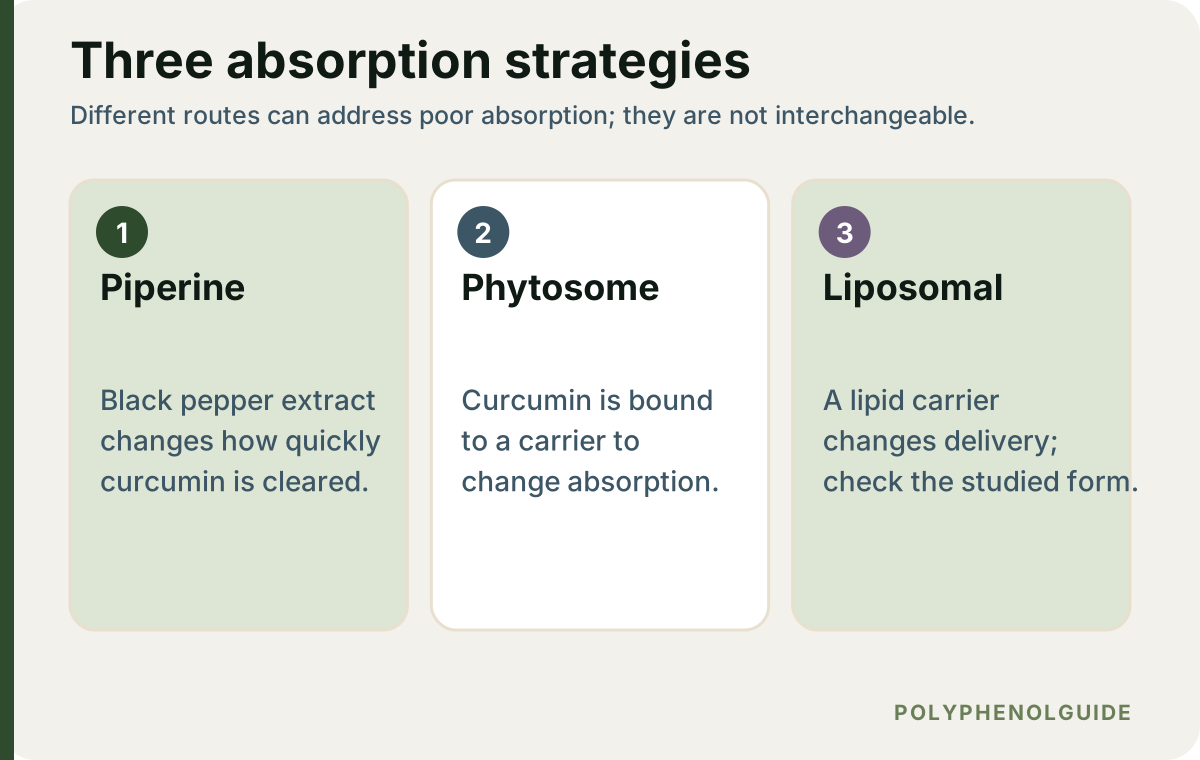
Curcumin on its own is poorly absorbed and cleared quickly. Every piperine, phytosome, and liposomal label on the shelf is trying to address that problem. Piperine comes from black pepper and slows how quickly the body clears curcumin. Phytosome and liposomal products bind curcumin to a carrier to change how it is absorbed after you swallow it.
Those extra steps often raise the price. Compare the exact form and serving amount before paying the premium. One bottle may provide a standardized extract with piperine in two capsules, while another uses a carrier system in one larger capsule. A front label that says “enhanced absorption” should identify the formulation in the Supplement Facts or other-ingredients panel. Better absorption can be useful when human evidence for a specific goal used that same form and dose. It doesn't automatically establish a better health outcome, and it doesn't make two differently formulated products interchangeable.
The four things worth reading
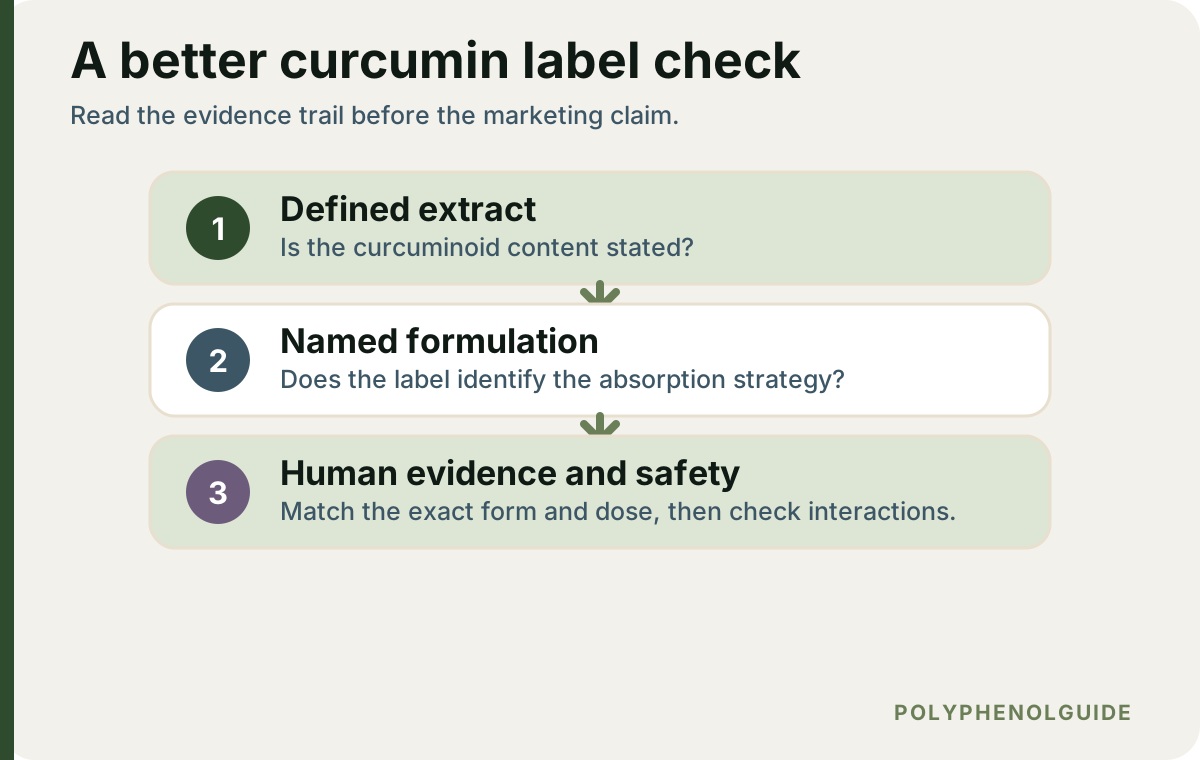
First, read the ingredient line for turmeric powder or a standardized curcuminoid extract. Second, find the absorption strategy: piperine, a phytosome carrier, a liposomal carrier, or none. Third, calculate the full serving, since a prominent capsule amount may be smaller than the daily serving shown in fine print. Fourth, look for a USP or NSF mark on the bottle.
Third-party testing means an outside laboratory checked whether the contents match the label. It doesn't prove the product improves a health outcome. Standardization defines the share of curcuminoids in the extract, but it doesn't prove good absorption. A named carrier explains the formulation, but it doesn't prove the premium changes how you feel. These limits make the label more useful, not less: each line answers one question. Check those lines on the actual bottle, since a product page can leave out the side panel. Photograph it before throwing the bottle away.
| On the label | What it means | What it does not mean |
|---|---|---|
| Turmeric root powder | Ground spice, with no extract listed | That a stated amount of curcuminoid is present |
| Standardized to 95 percent curcuminoids | How much active compound the extract carries | That the product is absorbed well |
| With piperine or black pepper extract | Added to slow how quickly curcumin is cleared | That any particular dose reaches you |
| Phytosome or liposomal | Bound to a carrier to change absorption | That the premium is matched by an outcome |
| USP or NSF mark | An outside laboratory checked contents against the label | That the product works |
| Supports a healthy inflammatory response | A structure or function claim | That it met a required standard of evidence |
The claims that carry no requirement
Dietary supplements reach U.S. shelves without Food and Drug Administration approval before sale. The manufacturer is responsible for product safety and labeling. A phrase such as “supports a healthy inflammatory response” is a structure or function claim. It can appear without an agreed regulatory meaning or a required standard of evidence, provided it doesn't claim to treat a disease.
The National Center for Complementary and Integrative Health also cautions that large amounts of antioxidants may interfere with normal cell signaling and defense mechanisms. A concentrated standardized extract deserves more attention than the spoonful of turmeric in dinner. Broad “support” language should send you back to the ingredient, form, dose, testing, and evidence. The smaller print may reveal that the claim applies to general body function, with no promise about the result you want. If a claim sounds impressive but vague, look for the specific human result behind it before paying a higher price at the nearby store shelf.
Before you buy one
Talk to a doctor or pharmacist before starting curcumin if you take blood-thinning medication, use other prescriptions, are pregnant, or are being treated for a health condition. Curcumin supplements can create dose and interaction questions that don't apply to seasoning dinner. Higher supplemental doses have also been associated with digestive upset in some people.
Bring a photo of the entire label, including the serving size and other ingredients. A clinician needs to see whether the bottle contains turmeric powder, a standardized extract, piperine, or a carrier formulation. Food is the foundation. Cooking turmeric with fat and black pepper is a longstanding kitchen pattern and provides the spice in ordinary food amounts. A curcumin supplement may be useful for a targeted goal when human evidence supports the exact form and dose. It can offer a standardized amount that kitchen seasoning can't reliably provide. That decision should come from the evidence and your health history, not the front-label promise.
What we still don't know
Formulations can change absorption, yet better absorption on paper doesn't settle whether a product improves the outcome you care about. The cooking pattern of turmeric with fat and pepper predates every carrier system on the shelf. For a given goal, which formulation and dose produce a meaningful benefit in people, and is that benefit large enough to justify the price?
Common questions about curcumin supplements
What is the best curcumin supplement on the market?
No single product earns that title from the information on a shelf. Check for a standardized curcuminoid amount, a named absorption strategy, a clear serving size, and outside testing such as USP or NSF. Then match the form and dose to human evidence for your specific goal.
Which brand is best for curcumin?
Brand rankings age quickly and can confuse packaging with evidence. A USP or NSF mark is a more useful label signal because it shows that an outside laboratory checked the contents. It still doesn't prove effectiveness. Compare standardization, formulation, serving size, and relevant human evidence across products.
What is the most effective form of curcumin?
Piperine, phytosome, and liposomal formulas all try to address curcumin's poor absorption and quick clearance. The best choice depends on whether human studies for your goal used that exact formulation and dose. Improved absorption alone doesn't guarantee a meaningful outcome, so read beyond the carrier claim.
Can turmeric cure gum disease?
Turmeric shouldn't be treated as a cure for gum disease. A cure claim requires direct clinical evidence for that condition, formulation, dose, and outcome. The label information covered here explains curcuminoid content and absorption strategies. It doesn't establish dental treatment. Ask a dentist about persistent gum symptoms.
Does curcumin need black pepper to work?
Black pepper isn't required in every curcumin product. Piperine, an extract from black pepper, is added to slow how quickly curcumin is cleared. Other products use phytosome or liposomal carriers. Choose based on the formulation studied for your goal, the listed dose, and professional guidance.
Is cooking with turmeric the same as taking a supplement?
Cooking with turmeric provides ordinary food amounts of the spice, often with fat and black pepper. A supplement uses concentrated turmeric or curcuminoid extract and can deliver a much larger dose. That concentration creates different questions about digestive effects, medication interactions, formulation, and professional guidance.