
The Anti-Inflammatory Mediterranean Diet: What the Trial Showed
Sep 9, 2026
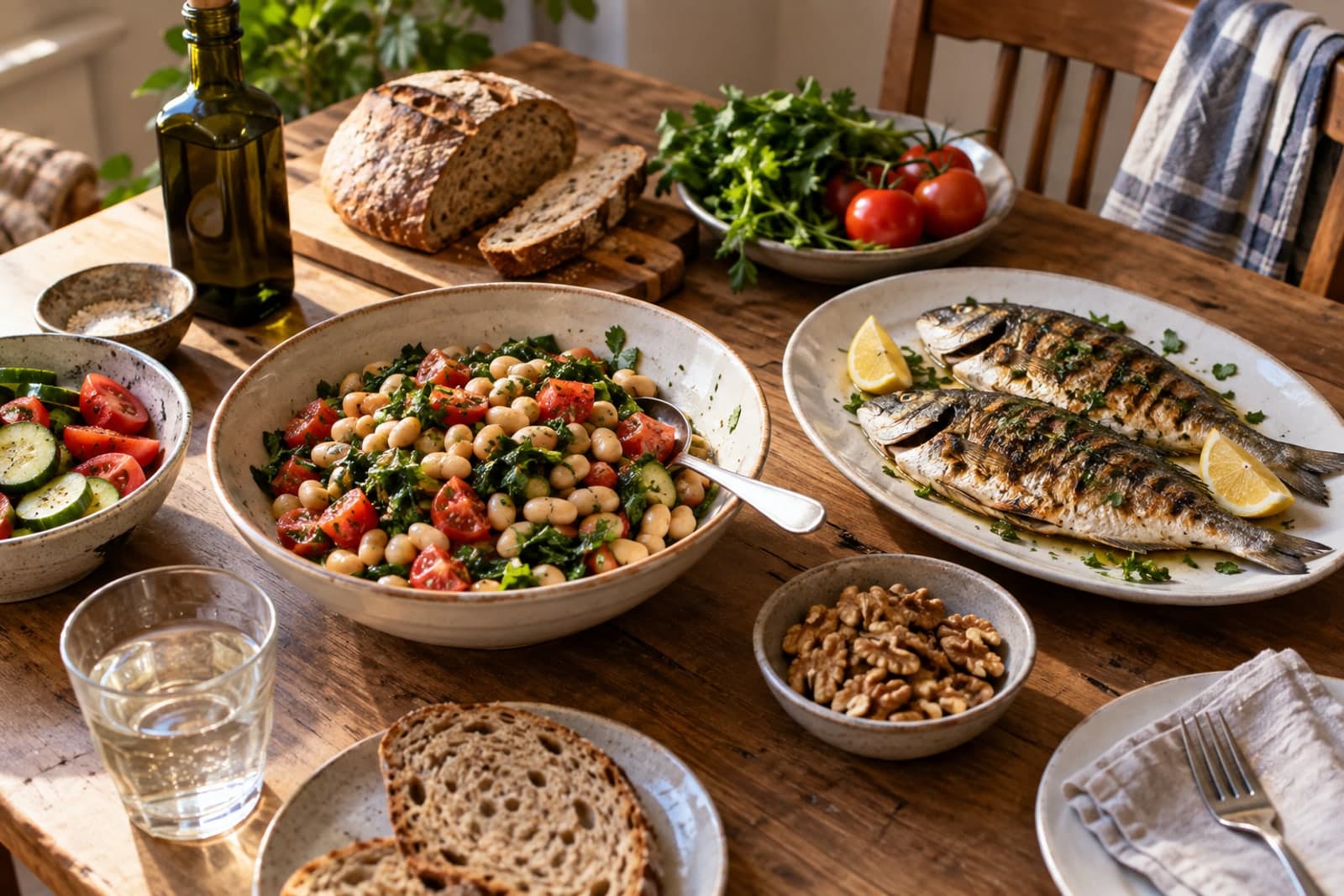
Someone tells you to eat an "anti-inflammatory diet," then leaves you with a word that can mean almost anything. The anti inflammatory Mediterranean diet earns more respect than most versions of that advice because researchers tested the whole eating pattern in a large randomized trial. They didn't test one spice, one juice or a list of foods with red circles around them. They tested a way of eating built around vegetables, beans, fish, whole grains, nuts and extra virgin olive oil. That distinction is the article. Here's what the trial found, what it had to correct and how to turn the pattern into an ordinary week of meals.
The trial everyone cites
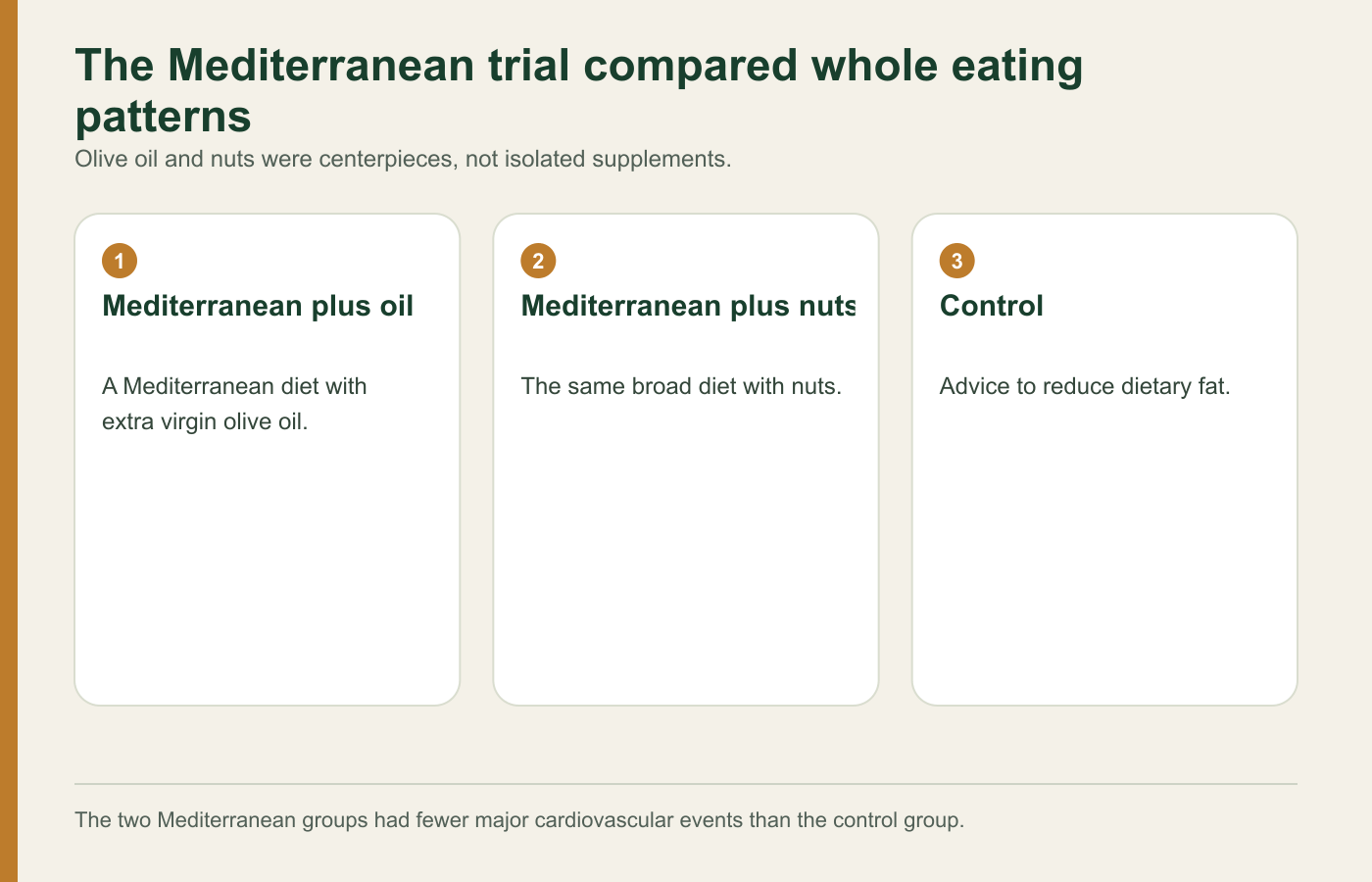
The study was PREDIMED, a 2018 New England Journal of Medicine trial that followed 7447 older adults at high cardiovascular risk. Researchers assigned one group to a Mediterranean diet supplied with extra virgin olive oil. Another group ate the same basic pattern with nuts. A control group received advice to reduce dietary fat.
Both Mediterranean groups had fewer major cardiovascular events than the control group. That's the result behind much of the confidence around this way of eating. The study followed people and tracked an outcome that mattered rather than stopping at a blood marker.
The trial also has a correction that shouldn't be tucked into a footnote. The original paper was retracted after researchers found problems with how some participants had been assigned to groups. The team reanalyzed the data and republished the work in 2018. The conclusion remained the same.
I don't see that history as a reason to throw the study out. I see it as a reason to describe it accurately. The corrected analysis still supports the Mediterranean pattern for the population that was studied, but the assignment problem belongs in any honest account.
One more limit matters. These were older adults who already had high cardiovascular risk. A healthy younger adult may still enjoy the pattern, but the trial can't promise the same size of benefit for a different population.
| Group | What they were asked to eat | Outcome |
|---|---|---|
| Mediterranean plus olive oil | Mediterranean diet with extra virgin olive oil | Fewer major cardiovascular events |
| Mediterranean plus nuts | The same diet with nuts | Fewer major cardiovascular events |
| Control | Advice to cut dietary fat | The comparison group |
What the diet actually is
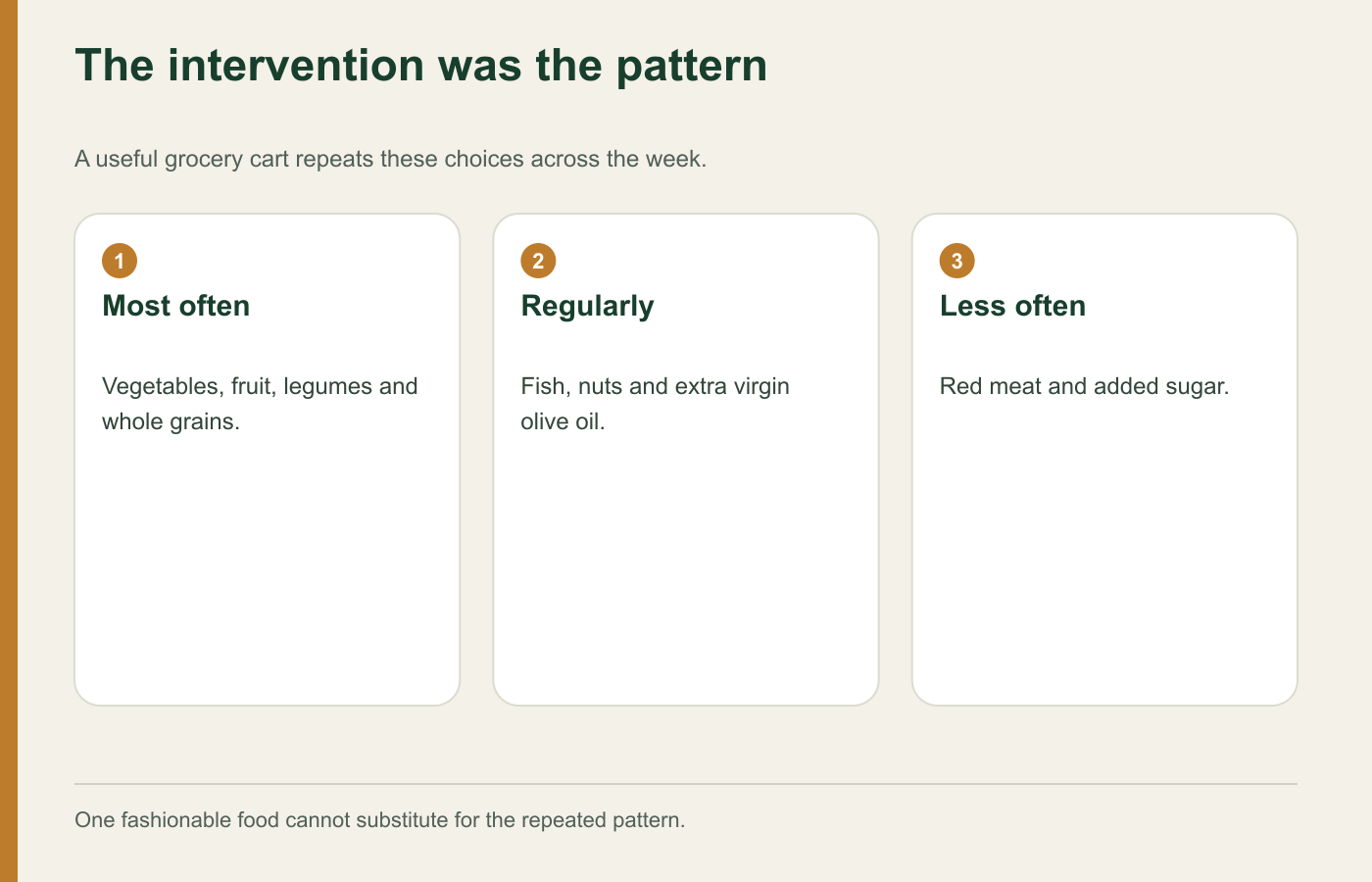
The Mediterranean pattern looks more like a grocery cart than a set of macros. Start with vegetables, fruit, beans and lentils. Add whole grains, fish, nuts and extra virgin olive oil. Red meat and added sugar show up less often. These polyphenol-rich foods work together, so no single ingredient gets to carry the whole diet.
For breakfast, that might be oats with fruit and nuts. Lunch can be white beans, chopped vegetables and olive oil over toast. Dinner might be fish with greens and a grain, or lentils cooked with tomatoes and onions. These aren't strict Mediterranean diet recipes. They're examples of the pattern doing its job.
A Mediterranean diet meal plan can help if a blank week makes you freeze, but it shouldn't turn the diet into a rigid challenge. Searches for a 21-day anti inflammatory diet often lead to aggressive resets with long restriction lists. The trial didn't ask people to complete a reset. It asked them to keep eating a recognizable pattern.
The same warning applies to a Mediterranean diet anti inflammatory pdf downloaded from a wellness site. A printable sheet is useful when it turns into groceries. Check whether its Anti inflammatory Mediterranean diet food list resembles the foods in the trial instead of treating the download itself as evidence.
If you want Anti inflammatory Mediterranean diet recipes, look for meals where plants make up most of the plate and olive oil replaces another fat. Soup, beans, chopped salads, roasted vegetables and fish all work. You don't need a geographically perfect menu. You need the food pattern to repeat.
That may sound less exciting than a detox calendar. It's also much closer to what researchers tested.
Why the pattern beats any single food
The PREDIMED intervention was the whole diet. Olive oil or nuts served as the centerpiece, but participants changed the rest of their eating too. That matters whenever someone tries to shrink the result down to "take olive oil" or "eat walnuts."
Nobody in the trial was drinking oil from a spoon as a daily dose. They cooked with it, dressed food with it and used it across meals. The oil helped make vegetables, beans and fish easier to eat. Nuts filled another practical role as a snack or meal ingredient. The foods worked inside a pattern.
You may be wondering which swap deserves the credit. The trial wasn't designed to isolate every part, so it can't name one winning food. That's frustrating for anyone hoping for a single answer. It also makes the results look more like the way people actually eat.
Anti-inflammatory is also a research description, not a regulated promise printed on one food. Anti inflammatory foods lists often mix strong and weak evidence, then imply that adding one berry cancels a diet built around refined snacks. The trial points in the other direction. Repeated choices matter more than a heroic ingredient.
This is why Anti inflammatory Mediterranean diet recipes should be judged as meals, not ingredient collections. A bean stew with vegetables and olive oil fits the intervention better than a sugary drink with one fashionable extract. The same goes for Anti inflammatory recipes more broadly.
The strongest move is substitution. Use olive oil where butter was doing the work. Put beans on the plate where processed meat used to sit. Add nuts as a snack instead of stacking them on top of everything else. A pattern changes when the defaults change.
Buying and storing the olive oil
Extra virgin olive oil brings hydroxytyrosol, oleuropein and oleocanthal to the pattern. Oleocanthal is responsible for the peppery catch at the back of your throat. That little cough from a fresh oil isn't a defect. It's a rough, imperfect field test that the oil still carries phenolics.
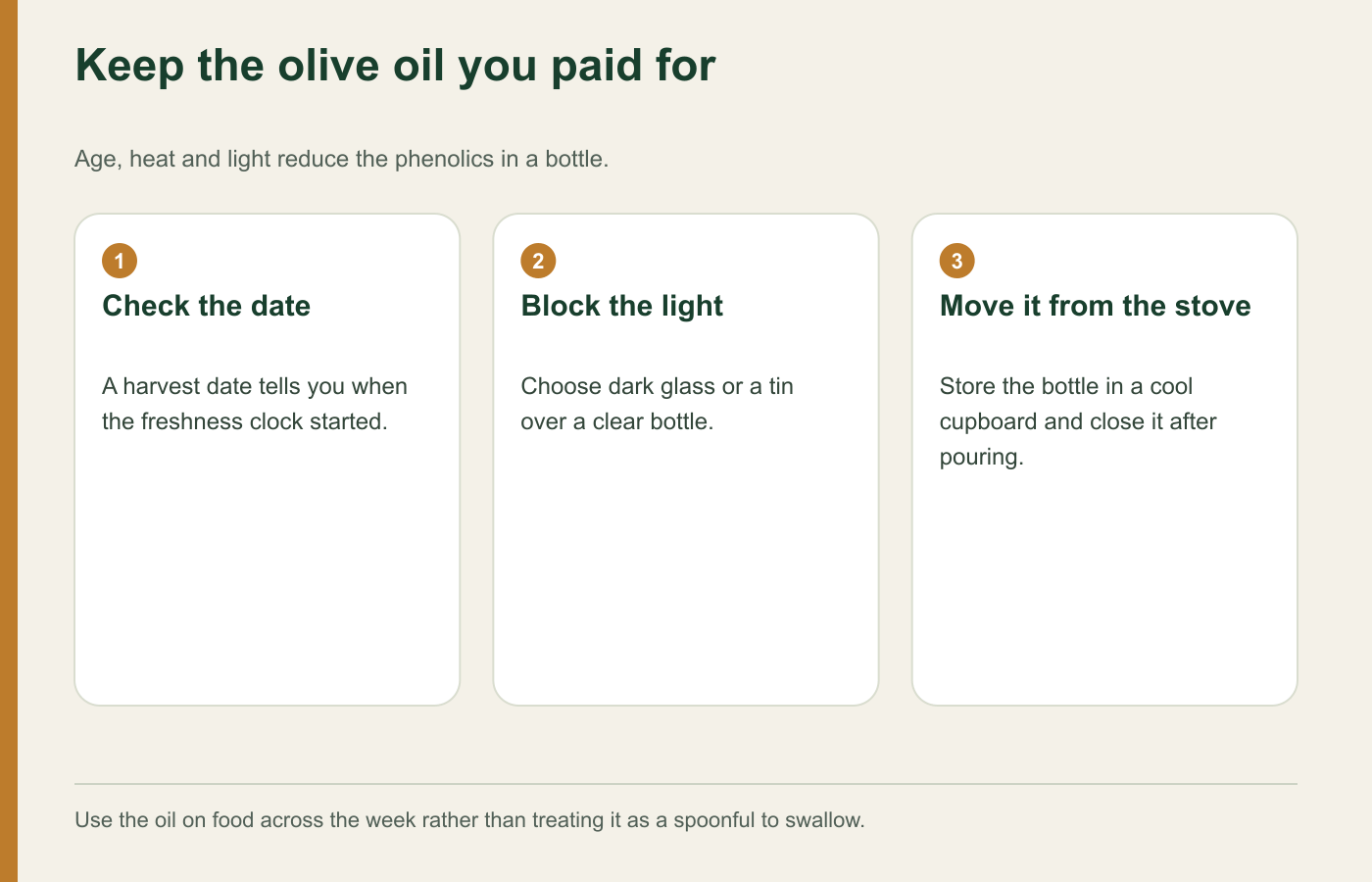
Lab reports usually express phenolic content in parts per million (ppm), and oils can range from under 100 to over 500 ppm. The amount falls with age, heat and light. A bottle that has spent months in clear glass under store lighting may have lost much of what you hoped to buy, even if the label looks expensive.
I check the harvest date first. A best-before date tells you when the seller wants the bottle used; the harvest date tells you when the olives started the clock. Then I look for dark glass or a tin. At home, the oil goes in a cupboard, not on the ledge beside the stove where heat and light reach it every day.
Refined and "light" olive oils have lost most of their phenolics during processing. Light refers to flavor, not calories. If the peppery compounds are part of why you're buying, extra virgin is the useful grade.
Use it on food. Dress beans, finish soup, roast vegetables or cook fish with it. That's how the oil appeared in the trial: across a way of eating. If you're comparing bottles tonight, pour a little into a spoon, taste it and wait. Fresh bitterness and a catch in the throat tell you more than a gold medal graphic you've never heard of.
The oil won't rescue an otherwise unrelated diet. It can make the tested pattern easier to live with. That's the difference between a claim on a bottle and what the research supports.
Common questions
What is the #1 most anti-inflammatory food?
The trial doesn't identify one winning food. It tested a Mediterranean pattern built around vegetables, fruit, legumes, whole grains, fish, nuts and extra virgin olive oil. Olive oil and nuts were the centerpieces, but the result belongs to the full eating pattern rather than a spoonful of any single ingredient.
What do you eat on the Mediterranean anti-inflammatory diet?
Build most meals from vegetables, fruit, beans or lentils, whole grains, fish, nuts and extra virgin olive oil. Eat less red meat and added sugar. A useful week repeats that pattern through ordinary meals such as oats, bean salads, vegetable soups, fish and grain bowls rather than a strict cleanse.
What are the top 3 inflammatory foods to avoid?
The trial didn't rank three forbidden foods. Its Mediterranean groups ate little red meat and little added sugar while emphasizing minimally processed plant foods, fish, nuts and olive oil. Use that as a pattern of substitutions instead of turning the diet into a short blacklist that ignores everything else you eat.
What is a good 7-day Mediterranean diet for beginners?
Plan a week around repeatable basics: oats and fruit, beans or lentils, vegetables, whole grains, fish, nuts and extra virgin olive oil. Cook enough beans or grains for several meals, then vary the vegetables and protein. A beginner plan works when the groceries are familiar enough to repeat next week.
Is the Mediterranean diet actually anti-inflammatory?
It earns the label better than most eating plans because a large randomized trial found fewer major cardiovascular events in high-risk adults assigned to Mediterranean patterns. Still, "anti-inflammatory" describes the pattern and its research. Regulators don't certify every food associated with the Mediterranean as medicine.
How much olive oil did the trial use?
The brief describes olive oil as a supplied centerpiece used across cooking and meals, not as a spoonful taken like a supplement. The important lesson is how it was used: on vegetables, beans, fish and other foods inside a Mediterranean pattern. Copy the pattern before trying to copy a dose.
Where to start this week
Pick one dinner you already make and rebuild it around the pattern. Add a bean or vegetable, use extra virgin olive oil in the cooking and move red meat out of the center. Do it again next week. That's more faithful to the anti inflammatory Mediterranean diet than downloading another Mediterranean diet anti inflammatory pdf or starting a second 21-day anti inflammatory diet. The intervention takes shape when that swap becomes routine.